
A potential customer can search Google for your business.
They can also ask ChatGPT:
"What are the best SEO agencies for a SaaS company?"
Or:
"Who can help a business improve its technical SEO?"
Or:
"Which SEO consultants work with international businesses?"
If your competitors appear in the answer and your business doesn't, the obvious question is:
How do you get ChatGPT to mention your business?
There isn't a button where you submit your company and ask ChatGPT to recommend you.
You also can't guarantee that ChatGPT will mention your business for a particular query.
What you can do is make your business easier for search systems and AI search experiences to discover, understand, evaluate and retrieve.
First, what does "mentioned in ChatGPT" actually mean?
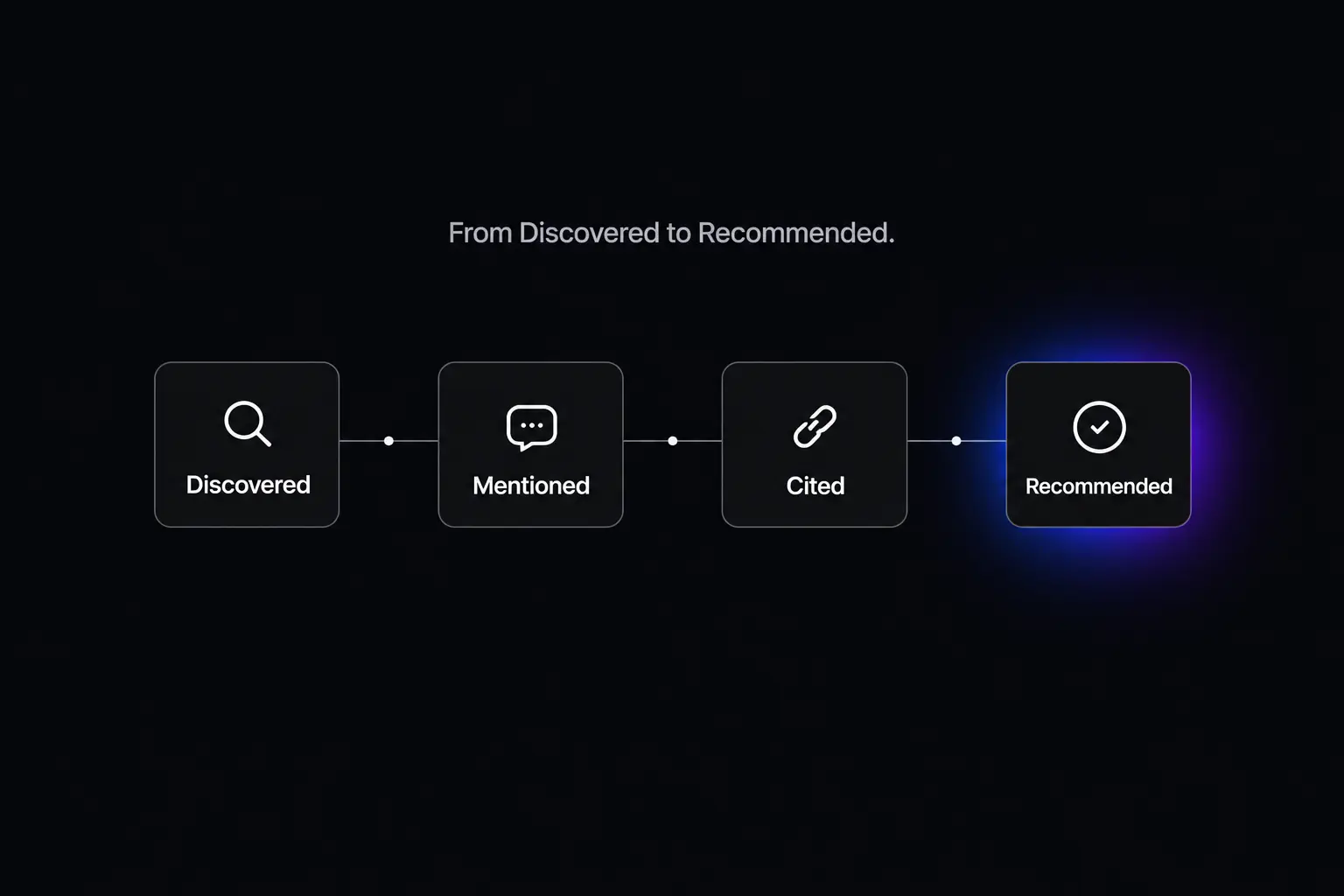
People use "mentioned" to describe several different things.
They're not exactly the same.
1. Discovered
ChatGPT can find information about your business somewhere on the web.
2. Mentioned
ChatGPT actually names your business in its response.
3. Cited
ChatGPT names your business and provides a source or link supporting the information.
4. Recommended
ChatGPT includes your business as an option when someone asks for recommendations.
These outcomes require different levels of visibility.
For example, having a page indexed does not automatically mean ChatGPT will recommend your company.
That's why I wouldn't approach AI visibility as:
"How do I rank #1 in ChatGPT?"
I'd approach it as:
"Can AI search systems find, understand, and confidently use information about my business?"
Can you submit your business directly to ChatGPT?
Not in the way many people assume.
There isn't a standard business directory where you enter your company and tell ChatGPT:
"Please recommend me."
Your website needs to exist as a useful, accessible source on the public web.
That makes the technical foundation important. Before working on AI visibility, I would first make sure your site can actually be crawled, indexed, and understood properly. If you're dealing with crawlability, indexing, redirects, or other technical problems, start with your technical SEO services.
OpenAI says any public website can appear in ChatGPT Search and recommends allowing OAI-SearchBot to crawl your website if you want your content to be discoverable.
Things you can influence
Whether your website is crawlable
What your website says about your business
How clearly your services are explained
Whether your content answers relevant questions
Whether your information is consistent
The quality of your content
Your internal linking
Your reputation and mentions across the web
The evidence you provide for your expertise
Things you cannot directly control
Whether ChatGPT mentions you
Which competitor appears
The exact wording ChatGPT uses
Which source ChatGPT chooses
Whether a particular query produces the same answer every time
Whether your business is recommended
Step 1: Make sure ChatGPT can access your website
Before worrying about content, make sure there isn't a technical problem preventing your pages from being discovered.
The first thing I'd check is your robots.txt.
But that's only one part of the technical check.
I'd also investigate:
robots.txtnoindexcanonical tags
HTTP status codes
redirects
server errors
CDN or firewall rules
bot protection
JavaScript rendering
internal links
XML sitemap
whether important pages are actually indexed
If you want to understand how I approach these problems, my technical SEO audit checklist covers many of the checks I use when diagnosing technical issues.
AI search doesn't magically remove the need for a technically accessible website.
Step 2: Make it obvious what your business actually does
Imagine an AI system lands on your homepage.
Can it quickly answer:
Who is this company?
What does it sell?
Who does it serve?
Where does it operate?
What makes it different?
What evidence supports its claims?
If the answer isn't obvious, you have an entity clarity problem.
For example, a business shouldn't rely on vague copy such as:
"We help ambitious brands unlock their digital potential."
That's marketing language.
A clearer version would be:
"We provide technical SEO and e-commerce SEO services for online retailers in the UK and US."
Now the subject, service, audience, and market are much clearer.
Your homepage, About page, service pages, industry pages, and contact information should tell a consistent story.
Step 3: Build a clear entity around your business
Your website isn't the only place where information about your business exists.
Think about your entire online footprint.
Website → LinkedIn → business profiles → industry publications → interviews → client websites → relevant directories → partnerships → reviews
The important part is consistency.
If one website says your company specializes in SEO for SaaS companies, another says you're primarily a web development company, and another lists a completely different location, you've created ambiguity.
I'm not suggesting that you create hundreds of directory listings just to create "AI signals."
Instead, build a legitimate, consistent presence where your business genuinely belongs.
Step 4: Create pages around the questions your customers actually ask
This is where SEO and AI search overlap heavily.
Your customers don't always search for your service name.
They search for problems.
For example, a business owner might ask:
Why did my Google traffic suddenly drop?
Why isn't my website ranking?
How long does SEO take?
Should I merge two pages targeting the same keyword?
Why is Google indexing the wrong page?
How do I improve local SEO?
How can I get my business mentioned in AI search?
These questions create opportunities for useful content.
But don't create 100 pages by changing a few words in the same template.
Build pages that genuinely answer different problems.
This is where On-Page & Content SEO becomes important. The goal isn't simply to publish more pages. It's to make each page useful for a specific search intent.
Step 5: Stop writing content that could have been written by anyone
This is one of the biggest differences between a normal SEO article and a potentially valuable source.
Compare these two statements.
Generic
"Technical SEO is important because it helps search engines crawl and understand your website."
There's nothing wrong with the statement.
But hundreds of websites can say the same thing.
First-hand
"During a technical audit, I found a site generating hundreds of crawl errors because internal links were repeatedly pointing to redirected URLs. The problem wasn't simply the number of errors. The crawl paths themselves were inefficient."
The second statement contains an observation.
It tells the reader:
Someone actually encountered this problem.
That's the type of experience I want to build into my own content.
Step 6: Give AI something specific to cite
If your article only contains generic advice, there may be little reason for another system to use it as a source.
Give it something useful.
That could be:
Original observations
Case studies
Original data
Frameworks
Comparisons
Practical examples
Expert commentary
For example:
Instead of:
"Keyword cannibalization can hurt rankings."
Explain:
"Before I merge two pages competing for the same keyword, I check whether the weaker URL is actually bringing valuable long-tail traffic. If it is, a 301 may remove more value than it creates."
That's much more useful.
Step 7: Build depth around your actual expertise
One article isn't enough to establish a strong topical footprint.
If you're an SEO consultant, your website should demonstrate depth across the subjects you actually work on.
For example:
SEO
Technical SEO
On-page SEO
Content SEO
SEO audits
E-commerce SEO
Local SEO
Link building
SEO strategy
AI Search
AI Overviews
ChatGPT Search
AI citations
GEO
AI search visibility
Entity understanding
AI search measurement
Your AI Search Visibility service is the natural commercial page to connect from this section because this article explains the problem, while that page explains how you can help solve it.
Then connect those topics through contextual internal links.
This creates a much clearer relationship between:
Muzammil → SEO → AI Search → specific expertise
Step 8: Strengthen evidence outside your website
Your own website is important.
But independent references can add another layer of credibility.
Think about legitimate opportunities such as:
industry publications
interviews
podcasts
expert contributions
client case studies
relevant business associations
industry partnerships
professional profiles
original research
The goal isn't:
"Get 500 backlinks because ChatGPT likes backlinks."
That's an oversimplification.
The goal is to create a web presence where information about your business is supported by relevant, independent sources.
Step 9: Don't confuse schema with AI optimization
Schema is useful.
But I wouldn't treat schema as a magic AI citation switch.
Structured data can help search engines understand content, but adding schema doesn't mean:
"ChatGPT will now recommend my business."
Use structured data where it accurately describes the content on the page.
Don't add markup simply because someone told you:
"This schema makes ChatGPT cite you."
Step 10: What about llms.txt?
You'll see a lot of discussion about llms.txt.
It's worth understanding, but I wouldn't build your entire AI search strategy around it.
Google currently says llms.txt isn't needed for Google Search and doesn't affect visibility or rankings there.
Your priorities should remain:
crawlability → useful content → clear entity information → strong internal architecture → evidence → authority
before spending significant time on optional files.
Step 11: Actually test what ChatGPT says about your business
This is where many businesses stop being theoretical.
Open ChatGPT and start testing.
Don't only search:
"What is Muzammil?"
That's a branded query.
Test queries a potential customer might actually ask.
Brand queries
Who is Muzammil SEO consultant?
Category queries
Who are SEO consultants in Karachi?
Problem queries
Who can help fix a website that suddenly lost Google traffic?
Commercial queries
What SEO consultants work with international businesses?
Comparison queries
What are some SEO consultants I could consider for an e-commerce website?
Record:
Query | Mentioned? | Cited? | Competitors | Sources |
|---|---|---|---|---|
Query 1 | Yes/No | Yes/No | Competitor A | URLs |
Query 2 | Yes/No | Yes/No | Competitor B | URLs |
Query 3 | Yes/No | Yes/No | Competitor C | URLs |
If you want to go deeper into why a site can rank in Google while remaining absent from AI answers, read Why Your Website Ranks on Google but Doesn't Appear in AI Answers.
Don't judge your visibility from a single conversation.
Step 12: When a competitor appears, investigate why
This is probably the most useful part of an AI visibility audit.
Suppose someone asks:
"Who are good SEO consultants for e-commerce?"
ChatGPT mentions your competitor.
Instead of saying:
"ChatGPT prefers my competitor."
Investigate the sources.
Look at:
Their website
What does it clearly say they specialize in?
Their service pages
Do they have specific pages matching the query?
Their content
Do they answer the questions being asked?
Their evidence
Do they show case studies, experience, data or original insights?
Their external presence
Where else are they mentioned?
Their entity consistency
Is the same business information repeated across reputable sources?
Their query alignment
Does their content actually match the problem being asked?
That's a much more useful analysis than trying to reverse-engineer a secret "ChatGPT ranking factor."
Step 13: Fix the gap instead of applying random GEO tactics
Once you've compared your website with the sources appearing in AI answers, you can identify the actual gap.
Problem | What I'd investigate | Possible action |
|---|---|---|
Website isn't accessible | Crawling, robots, server issues | Fix technical access |
Business isn't clearly understood | Homepage, About, service information | Improve entity clarity |
No relevant page exists | Search intent and content coverage | Create a useful page |
Content is generic | First-hand experience and evidence | Add original insights |
Competitors have stronger evidence | Case studies, mentions, publications | Build legitimate authority |
Important pages are disconnected | Internal linking | Improve site architecture |
Can't measure visibility | Query set and tracking | Establish AI search monitoring |
This is also why I recommend doing a proper SEO audit and strategy before making large-scale changes. The same principle applies here: diagnose the problem first, then decide what actually needs fixing.
My framework for improving AI search visibility
When I audit AI visibility, I'd break the problem into six areas:
1. Access
Can search systems access the important content?
2. Entity
Is it obvious who the business is and what it does?
3. Relevance
Does the website answer the questions people actually ask?
4. Evidence
Does the site contain original experience, data, examples and useful information?
5. Authority
Are there credible signals outside the website supporting the entity and its expertise?
6. Measurement
Are you actually testing AI search queries and tracking what happens?
Access → Entity → Relevance → Evidence → Authority → Measurement
If something is missing, I fix that specific problem instead of applying random GEO tactics.
What I would do in the first 7 days
If I had a business that wasn't appearing in AI answers, I wouldn't immediately publish 50 articles.
I'd start with a diagnostic.
Day 1
Define 20 to 30 real customer questions.
Day 2
Test those questions across relevant AI search experiences.
Day 3
Record which competitors and sources appear.
Day 4
Study the pages being cited.
Day 5
Audit my own website's crawlability, indexing and architecture.
Day 6
Compare my content, entity information and evidence against the sources appearing.
Day 7
Create a prioritized action list.
Then I'd start fixing the biggest gaps.
That's essentially the same philosophy I use with traditional SEO:
Diagnose first. Change second.
What you cannot guarantee
No legitimate SEO or GEO consultant should promise:
"I'll make ChatGPT recommend your business."
You can't control the final answer.
You can't guarantee a particular mention.
You can't guarantee a specific citation.
And you can't guarantee that an AI response will remain unchanged.
What you can do is improve the information available to search systems and make your business easier to discover, understand and evaluate.
That's a much more realistic goal.
Does SEO still matter for ChatGPT and AI search?
Yes, especially for AI search experiences that retrieve information from the web.
The exact systems differ between platforms, so I wouldn't assume that Google and ChatGPT work identically.
But the fundamentals still matter:
crawlable pages
indexable content
clear information architecture
useful content
relevant internal links
strong topical coverage
clear entities
evidence and expertise
reputable external references
So I don't see AI search as replacing SEO.
I see it as adding another way people discover information.
Final thoughts
If your competitors are appearing in AI answers and your business isn't, I wouldn't start by adding random GEO tactics.
I'd first ask:
Can AI search systems access my content?
Do they clearly understand what my business does?
Do I have pages that answer the questions my customers actually ask?
Does my website contain information worth citing?
Is there credible evidence about my expertise outside my own website?
What sources are being used when my competitors appear?
That's the approach I take with AI search visibility.
The goal isn't to trick ChatGPT into mentioning your business.
The goal is to build a business presence that is easy to discover, easy to understand, relevant to the query, and supported by useful evidence.
And that's where SEO and AI search start to overlap.
Frequently Asked Questions
There isn't a standard submission form that guarantees your business will be mentioned. OpenAI says public websites can appear in ChatGPT Search and recommends allowing OAI-SearchBot to crawl your site.
SEO can help make your website accessible, understandable and relevant to search systems. However, traditional Google rankings do not guarantee a ChatGPT mention.
No guarantee exists. Use structured data to accurately describe your content rather than treating it as a shortcut to AI recommendations.
Not as a requirement for Google Search. Google currently says llms.txt isn't needed for Google Search and doesn't affect visibility or rankings there.
Test realistic, unbranded customer queries and record whether your business is mentioned, whether your website is cited, which competitors appear and which sources are being used.
No. You can improve the conditions that make your business discoverable and useful as a source, but you cannot control the final answer.
Want to improve your AI search visibility?
If your business isn't appearing in ChatGPT, Google AI or other AI search experiences, I can help identify where the visibility gap is coming from. I look at the technical side, content, entity clarity, search intent, internal architecture and external evidence before recommending what to change.
Get a Free Strategy Call