
Link building in 2026 still works — but only if you earn links through genuine value, not manipulation. The tactics that deliver results are content-driven outreach, digital PR, broken link building, and strategic partnerships. Black-hat schemes like buying links, PBNs, and link farms will get you penalized faster than ever as Google’s AI detection improves. This guide covers exactly what works, what’s too risky, and how to build authority safely.
Last month, a business owner contacted me after his site lost 60% of its organic traffic overnight. His previous SEO agency had built 200+ backlinks in three months. Sounds impressive until you realize they were all from PBNs and paid directories. Google’s spam detection caught it, and he got hit with a manual penalty.
Recovery took eight months. Disavowing toxic links. Rebuilding authority from scratch. Lost revenue during that period? Over $40,000.
That’s the cost of bad link building.
But here’s the flip side: one of my clients earned a single backlink from a DR 78 industry publication through strategic outreach. That link drove more referral traffic in one month than their previous 30 directory submissions combined. Rankings jumped. Leads increased. Zero penalty risk.
The difference? Quality, legitimacy, and strategy.
After 8+ years building links for businesses across Pakistan and internationally, I’ve seen what works, what’s a waste of time, and what gets sites penalized. This is everything you need to know about building backlinks safely and effectively in 2026.
Why Link Building Still Matters in 2026
Every few years, someone declares that “link building is dead.” They’re always wrong.
Backlinks remain one of Google’s strongest ranking signals. Google’s own documentation confirms this. Their algorithms use links to understand authority, relevance, and trustworthiness.
What’s changed is how Google evaluates links. Quality now massively outweighs quantity. Context matters more than raw numbers. And manipulation gets caught faster.
How Google Uses Backlinks in 2026
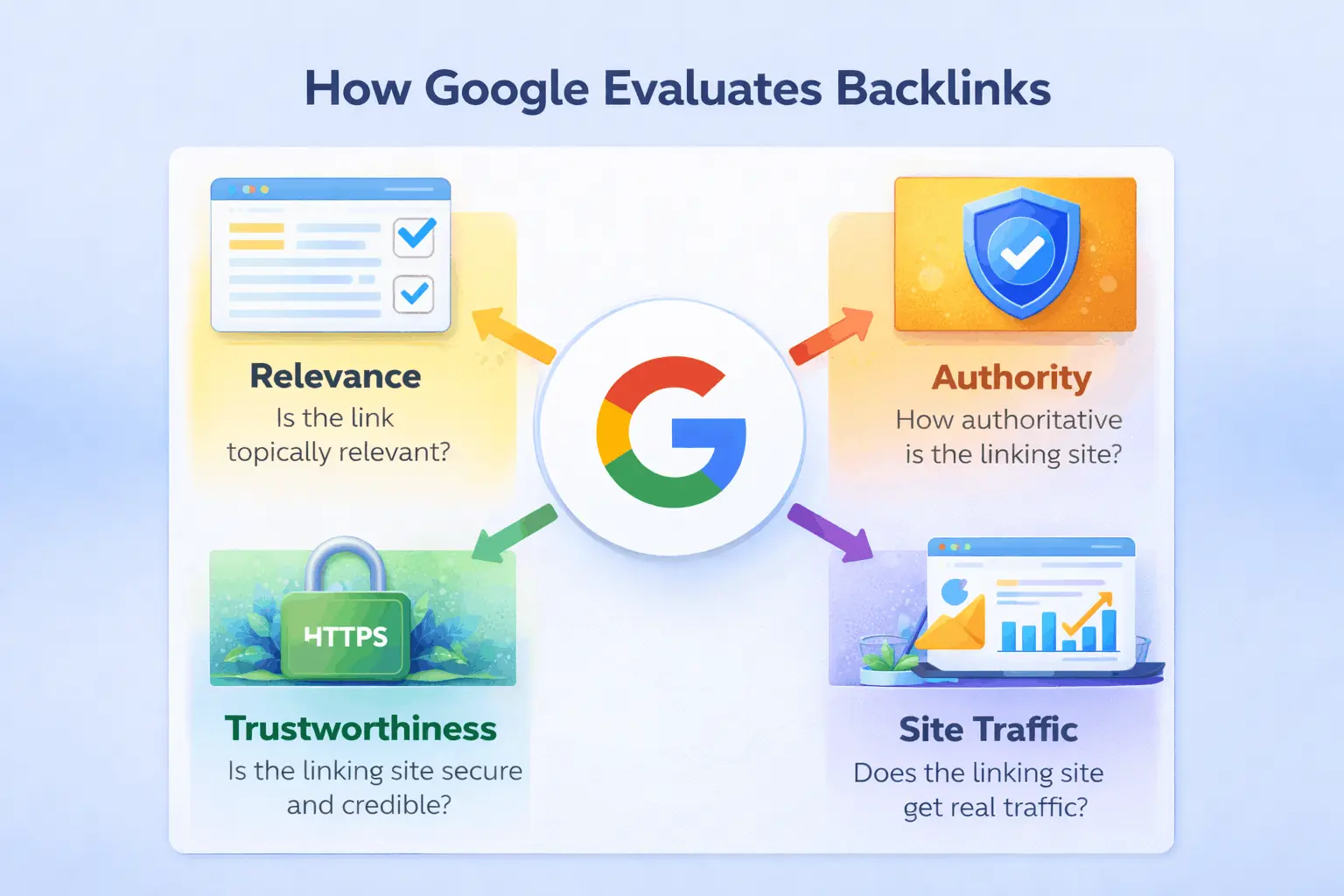
Google’s algorithms analyze backlinks across multiple dimensions:
Source authority: A link from a well-established, authoritative site passes more value than one from a new, unknown blog.
Topical relevance: A link from a site in your industry carries more weight than one from an unrelated site.
Anchor text context: The words used to link matter, but over-optimization triggers spam filters.
Link placement: Contextual links within content are valued higher than footer or sidebar links.
Natural link velocity: Sudden spikes in backlinks look manipulative. Organic growth is gradual.
Link diversity: A healthy backlink profile includes links from various domains, not just a few repeated sources.
Google’s AI can now detect patterns that indicate manipulation. If your link profile looks unnatural, all links acquired in one month, all using the same anchor text, all from low-quality sites, you’re flagged.
The Compounding Value of Quality Links
Quality backlinks compound over time. A link earned today continues passing authority months and years later. This is why link building remains one of the highest-ROI SEO investments.
I’ve tracked backlinks I built for clients three years ago. Many still drive referral traffic and contribute to rankings. Compare that to paid ads, where traffic stops the second you stop paying.
The key is building links that last, links from stable, authoritative sources that won’t disappear or get deindexed.
Link Building Strategies That Still Work in 2026
These are the white-hat link building methods I use with every client. They work because they’re based on creating genuine value, not gaming systems.
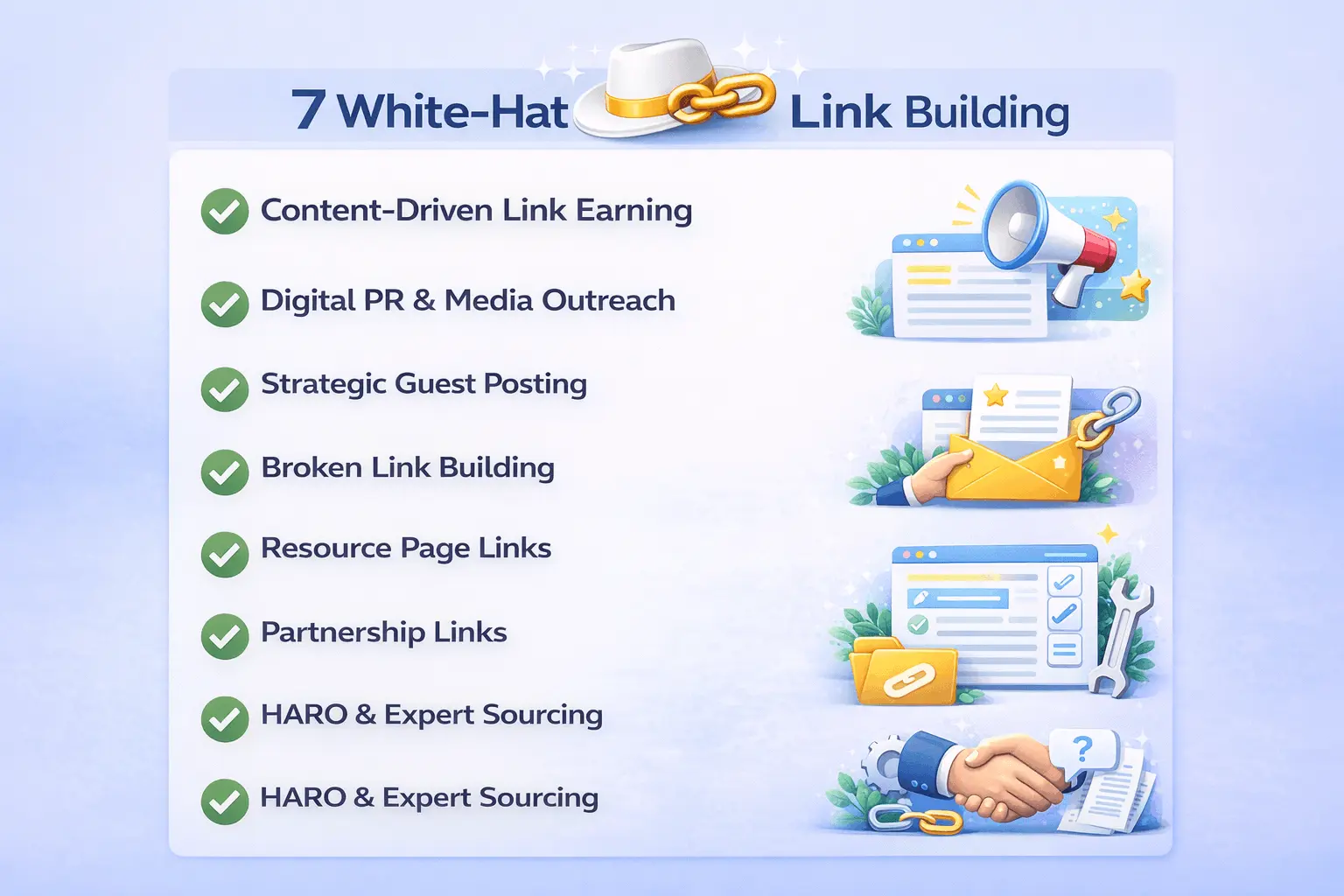
1. Content-Driven Link Earning
The most sustainable link building strategy is creating content so valuable that people naturally want to reference it.
This means:
Original research: Conduct surveys, analyze data, share unique findings. Industry publications love citing original research.
Comprehensive guides: In-depth resources that become the definitive reference on a topic. Like this article on my technical SEO audit process.
Data visualizations: Charts, infographics, interactive tools. Visual content gets shared and linked more than text alone.
Case studies: Real results with specific numbers. People link to proof, not claims.
Tools and calculators: Free resources that solve problems. A mortgage calculator or SEO audit tool naturally attracts backlinks.
The best part? Once created, linkable assets continue earning links passively. One comprehensive guide I wrote for a client has earned 40+ backlinks over 18 months with zero additional outreach.
2. Digital PR & Media Outreach
Getting featured in news publications, industry media, and authoritative blogs is one of the fastest ways to build high-quality backlinks.
How this works:
Newsjacking: Comment on trending industry news with expert insights. Journalists looking for quotes will link to you.
Press releases (done right): Announce genuinely newsworthy events — new products, research findings, major milestones. Not fluff.
Expert commentary: Build relationships with journalists in your industry. When they need an expert source, they’ll reach out.
Thought leadership content: Publish contrarian or insightful takes that media outlets want to reference.
In Pakistan, publications like Dawn, The News, and industry-specific media are actively looking for expert voices. Pitch them angles tied to business trends, economic analysis, or technology developments.
3. Strategic Guest Posting (Done Right)
Guest posting gets a bad reputation because it’s been abused. But when done legitimately, it’s still effective.
The difference between spam and strategy:
Quality sites only: Target authoritative, established publications with real editorial standards. Not sites that accept any guest post.
Genuinely valuable content: Write in-depth articles that serve the publication’s audience. Not thinly-veiled sales pitches.
Relevant topics: Your content should fit the site’s niche naturally. An SEO expert guest posting on a marketing blog makes sense. On a cooking blog? No.
Natural anchor text: Link to your site using branded anchors or natural phrases. Not keyword-stuffed exact-match anchors.
Limited links: One or two contextual links maximum. Not ten links crammed into a 500-word article.
I’ve had guest posts on DR 60+ sites drive both backlink value and direct referral traffic. The key is treating guest posting as relationship building, not link extraction.
4. Broken Link Building
This is one of my favorite tactics because it creates a win-win situation.
The process:
Find broken links on authoritative sites in your niche (using Ahrefs or Check My Links)
Create content that covers the same topic as the dead page
Email the site owner pointing out the broken link
Suggest your content as a replacement
Why this works: you’re helping them fix a problem (broken links hurt UX and SEO) while earning a legitimate backlink. My response rate on broken link outreach averages 15-20%, significantly higher than cold pitching.
Real example: I found 8 broken links on resource pages about SEO tools. Created a comprehensive tools comparison guide. Reached out to all 8 sites. Got 5 backlinks within two weeks.
5. Resource Page Link Building
Many sites maintain curated resource pages — “Best SEO Tools,” “Marketing Resources,” “Industry Guides.” Getting listed on these pages earns contextual, relevant backlinks.
How to find them:
Search: [your topic] + “resources”
Search: [your topic] + “helpful links”
Use Ahrefs to find pages linking to your competitors
Pitch requirements:
Your content must be genuinely helpful
It should fit the resource page’s theme
Your outreach email explains why it’s valuable for their audience
Resource pages are maintained by people actively curating quality content. If yours meets the bar, you get added.
6. Partnership & Collaboration Links
Building relationships with complementary businesses creates natural link opportunities.
Examples:
Vendor/supplier links: If you use a service or tool, many vendors maintain a customer showcase page. Ask to be featured.
Co-marketing initiatives: Partner with non-competing businesses on webinars, guides, or research. Both parties link to the collaborative content.
Industry association memberships: Karachi Chamber of Commerce, professional associations — members often get profile pages with backlinks.
Sponsorships: Sponsor local events, conferences, or community initiatives. Many include website links in sponsor recognition.
These links are legitimate because they represent real business relationships, not manipulated placements.
7. HARO & Expert Sourcing
Help a Reporter Out (HARO) connects journalists with expert sources. Respond to relevant queries with thoughtful insights, and you’ll get quoted in articles with backlinks to your site.
Similar platforms exist globally. The approach:
Monitor queries in your industry
Respond quickly with specific, quotable insights
Include your credentials and site URL
Follow up professionally if selected
HARO links often come from high-authority news sites and industry publications — exactly the kind of backlinks that move rankings.
Link Building Tactics That Will Get You Penalized
Google’s penalty system has gotten significantly more sophisticated. Here are the tactics that will get you caught, and the consequences aren’t worth it.
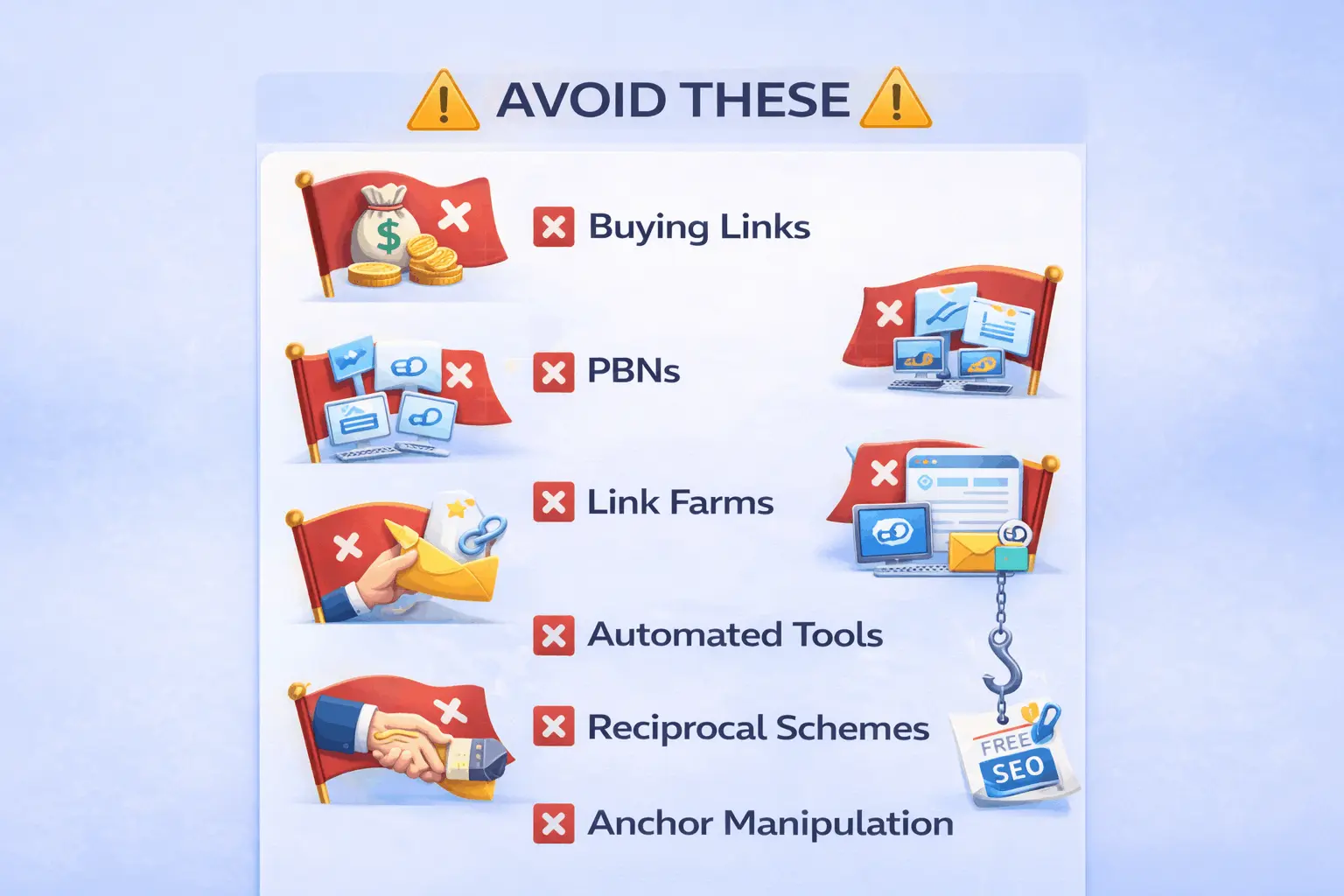
1. Buying Links from Shady Marketplaces
Sites like Fiverr are flooded with offers: “100 backlinks for $50!” or “DA 50+ links guaranteed!”
These are always low-quality, spammy links from link farms. Google detects them immediately. The pattern is obvious — dozens of links from unrelated sites, all acquired at once, all pointing to commercial pages with exact-match anchors.
I’ve had to clean up after providers like this. One client had 300+ toxic backlinks to disavow. Recovery took 7 months.
2. Private Blog Networks (PBNs)
PBNs are networks of sites created solely to link to money sites. They look legitimate on the surface but exist only for link manipulation.
Google is extremely good at detecting PBNs:
Similar hosting footprints
Overlapping WHOIS information
Unnatural interlinking patterns
No real traffic or engagement
When Google identifies a PBN, every site linked from it gets penalized. Not just devalued, actively penalized. Manual actions, ranking drops, potential deindexing.
The risk-reward ratio is terrible. One high-quality earned link beats 50 PBN links.
3. Link Farms & Directory Spam
Submitting your site to hundreds of low-quality directories is outdated and harmful.
Legitimate directories like Google Business Profile or industry-specific directories are fine. But bulk directory submission services that add you to 500 random directories? Those links hurt more than they help.
Red flags:
Directories accept any site without review
Massive lists of unrelated businesses
No traffic, no authority, no editorial standards
Filled with spam and low-quality sites
4. Automated Link Building Tools
Software that automatically creates forum profiles, blog comments, or web 2.0 sites and drops your links everywhere is pure spam.
Google’s spam detection identifies these patterns instantly:
Hundreds of links created simultaneously
Identical or templated anchor text
Links from irrelevant, low-quality sources
No real context or value
Automation can help with outreach tracking or prospecting. But automated link placement? Guaranteed penalty.
5. Reciprocal Link Schemes
“I’ll link to you if you link to me” arrangements are fine when natural and relevant. But organized reciprocal linking schemes — where dozens of sites all link to each other in a circular pattern — trigger spam filters.
Google’s algorithms detect these networks. If Site A links to Site B, Site B links to Site C, and Site C links back to Site A in a closed loop, that’s manipulation.
Legitimate partnerships where businesses naturally reference each other? Fine. Coordinated schemes designed to inflate link counts? Penalized.
6. Exact-Match Anchor Text Manipulation
Over-optimizing anchor text is one of the easiest ways to trigger a penalty.
If 80% of your backlinks use the exact keyword you’re targeting — “SEO services Karachi,” “best lawyer in Lahore,” etc. — Google knows it’s manipulated. Natural link profiles have variety:
Branded anchors (“Muzammil,” “Muzammil SEO”)
Generic anchors (“click here,” “this article,” “learn more”)
Naked URLs (“marketermuzammil.com”)
Partial-match anchors (“SEO consultant,” “digital marketing expert”)
Exact-match (sparingly — maybe 10-15% of total)
Aim for 60-70% branded/generic, 20-30% partial match, and only 10-15% exact match.
How to Identify Quality vs. Low-Quality Links
Not all backlinks are created equal. Here’s how I evaluate link quality before pursuing or accepting them.
Domain Authority & Relevance
Use Ahrefs Domain Rating (DR) or Moz Domain Authority (DA) as rough quality indicators. But don’t obsess over the number.
A DR 40 site highly relevant to your niche is better than a DR 70 site with no topical connection. Relevance matters more than raw authority.
Ask:
Is this site in my industry or a related field?
Does linking to me make sense for their audience?
Would I naturally discover this site while researching my topic?
Traffic & Editorial Standards
Check if the site gets real traffic using SimilarWeb or Ahrefs. Sites with zero traffic have zero value.
Look at content quality:
Is it well-written and informative?
Does it have an editorial process?
Are there clear author bios and credentials?
Do they publish regularly?
Sites with high editorial standards are harder to get links from — which is exactly why those links are valuable.
Natural vs. Manipulated Placement
Where does the link appear?
High value: Contextual link within the main content, placed naturally where it adds value to the reader.
Medium value: Author bio link, resource section, related articles sidebar.
Low/No value: Footer links, sitewide sidebar links, comment sections, clearly paid placement markers.
Google values editorial links — placements made because someone genuinely thought your content was worth referencing.
My Link Building Process: A Real Framework
Here’s the systematic approach I follow for every link building campaign:
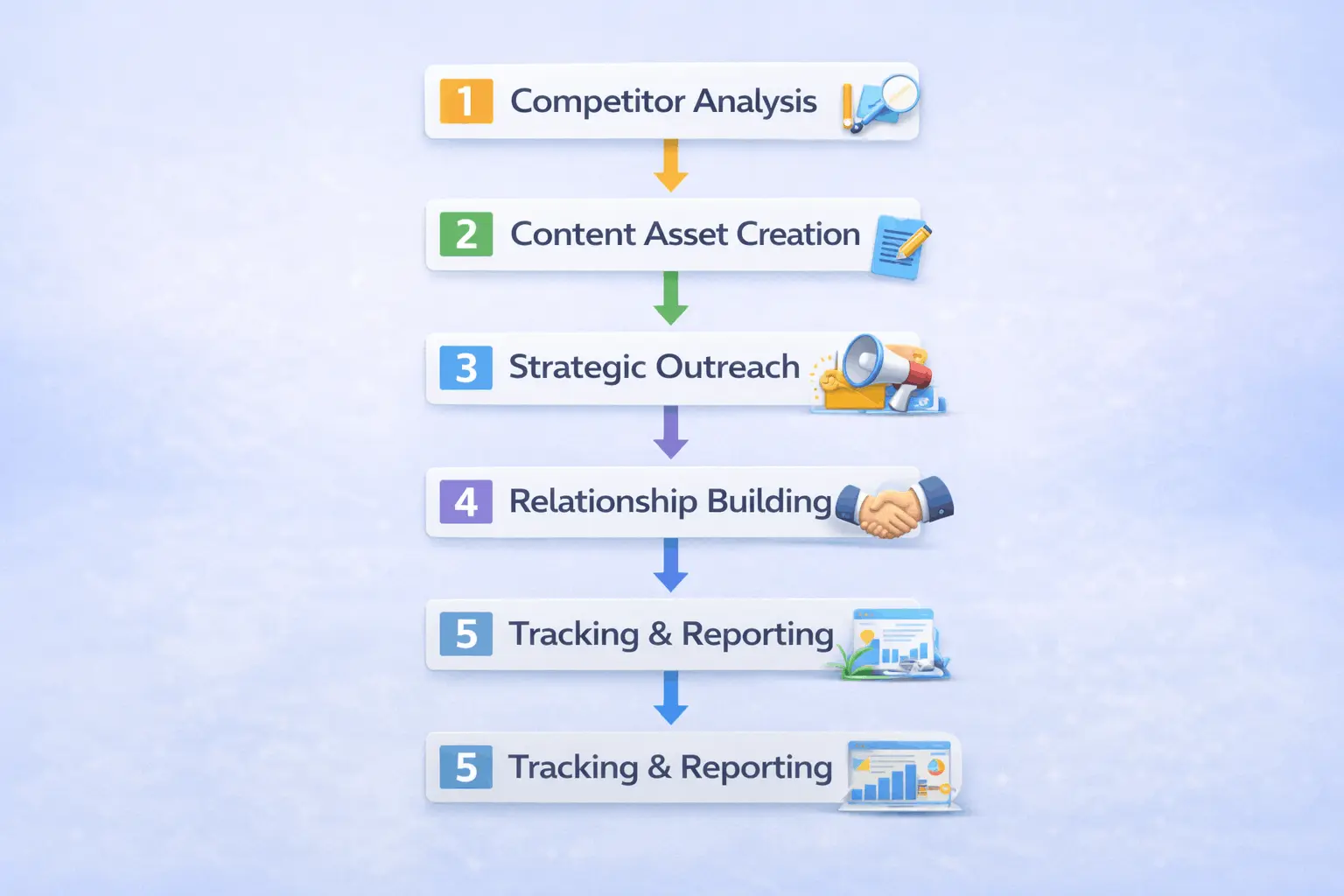
Step 1: Competitor Backlink Analysis
I start by analyzing where competitors get their links. Using Ahrefs:
Enter competitor domains
Review their backlink profile
Identify high-quality referring domains
Note what types of content earn links
Find link opportunities we can replicate or improve on
If a competitor has links from 5 industry publications, those same publications are prospects for us.
Step 2: Content Asset Creation
Link building requires something worth linking to. I either optimize existing content or create new linkable assets:
Comprehensive guides (like this article)
Original research or data
Tools, templates, or calculators
Visual content (infographics, charts)
Case studies with specific results
The asset must provide genuine value. Nobody links to mediocre content.
Step 3: Strategic Outreach
I build a prospect list of sites likely to link based on:
Topical relevance
Domain authority (DR 30+)
Existing content gaps our asset fills
Sites that linked to similar content from competitors
Then I craft personalized outreach emails. Not templates, personalized messages that reference their specific content and explain why our resource benefits their audience.
My outreach structure:
Subject: Specific reference to their content
Opening: Genuine compliment on something they published
Value prop: Brief explanation of what we created and why it’s useful
Soft ask: Suggest it might be worth linking to
Sign off: Professional, no pressure
Average response rate: 12-18%. Average conversion to backlink: 6-10%.
Step 4: Relationship Building
One-off transactional link requests rarely work. I focus on building ongoing relationships:
Engage with their content on social media
Comment thoughtfully on their blog posts
Share their content when it’s valuable
Offer genuine value before asking for anything
Relationships compound. One editor I built a relationship with has linked to client content 4 times over 18 months.
Step 5: Tracking & Reporting
I track every backlink earned:
Source domain and DR
Target page linked to
Anchor text used
Date acquired
Whether it’s dofollow or nofollow
Monthly reports show link growth, cumulative authority built, and correlation with ranking improvements.
Common Link Building Mistakes I See Constantly
Even businesses with good intentions make these errors:
Prioritizing quantity over quality: 100 low-quality links won’t move rankings. 5 authoritative, relevant links will.
Ignoring relevance: A backlink from a high-authority but completely unrelated site provides minimal value.
Only building links to the homepage: Link to relevant internal pages — service pages, blog posts, location pages. Diversify your link targets.
Neglecting existing content: You don’t always need new content. Update and promote existing high-quality pages to earn links.
No follow-up: One outreach email isn’t enough. Polite follow-ups (2-3 weeks later) increase response rates significantly.
Giving up too soon: Link building is slow. Results compound over months, not days. Consistency wins.
Not disavowing toxic links: If you inherit bad backlinks from previous SEO work, disavow them through Google Search Console. Don’t let toxic links drag you down.
How Long Does Link Building Take to Show Results?
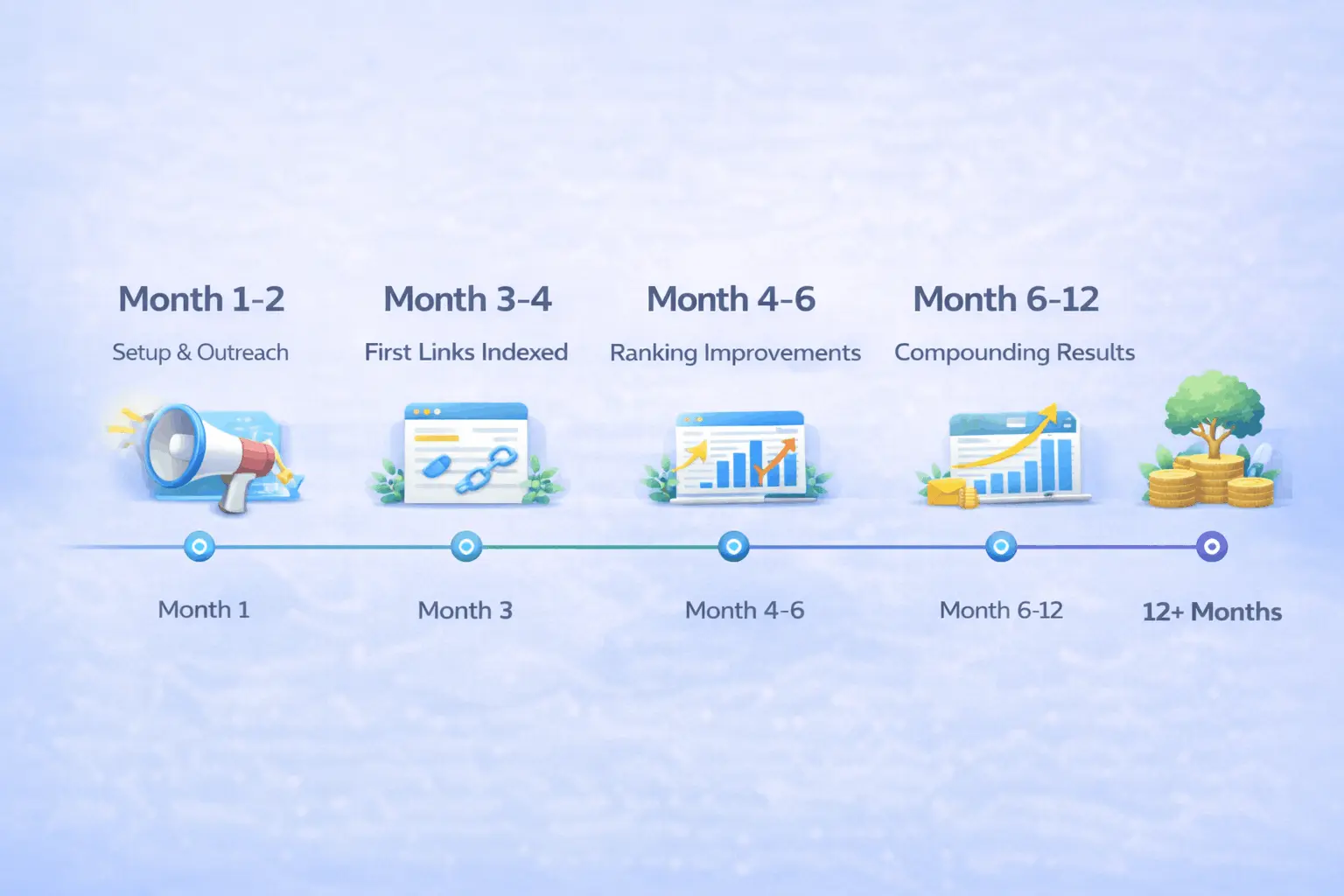
Link building isn’t instant. Here’s the realistic timeline:
Week 1-4: Building prospect lists, creating content assets, initial outreach. No visible ranking impact yet.
Month 2-3: First backlinks start getting indexed. You may see small ranking movements for less competitive keywords.
Month 4-6: Cumulative authority builds. More noticeable ranking improvements, especially if combined with strong on-page optimization and technical SEO.
Month 6-12: Compounding effects. Rankings for competitive keywords improve. Organic traffic increases measurably.
Beyond 12 months: Link building becomes a consistent growth driver. Each new quality link adds to cumulative authority.
Variables that affect speed: your starting domain authority, competition level, quality of links earned, and how well your content strategy supports link acquisition.
Should You Build Links Yourself or Hire a Professional?
Honest assessment:
You Can DIY If:
You have time to research, create content, and do outreach
You’re willing to learn tools like Ahrefs
You have strong writing and relationship-building skills
You understand SEO fundamentals
You’re patient and persistent
DIY link building is feasible for small businesses in non-competitive niches.
Hire a Professional If:
You’re in a competitive industry
Your time is better spent running your business
You’ve tried DIY and results are slow
You want to avoid risky tactics
You need proven results within a specific timeline
Professional link builders have established relationships, proven outreach frameworks, and experience identifying quality opportunities. They also know what tactics to avoid.
Check out my guide on choosing an SEO expert if you’re evaluating providers.
Frequently Asked Questions About Link Building
Is link building still important in 2026?
Yes. Backlinks remain one of Google’s top three ranking factors. What’s changed is that quality now matters far more than quantity, and manipulation gets caught faster.
How many backlinks do I need to rank?
There’s no magic number. It depends on your competition. Check how many quality backlinks your top-ranking competitors have and aim to match or exceed that. One DR 70 link can outweigh 50 DR 20 links.
Can I buy backlinks safely?
No. Buying links violates Google’s guidelines and risks penalties. The only safe approach is earning links through legitimate methods like content, outreach, and relationships.
What’s the difference between dofollow and nofollow links?
Dofollow links pass authority (“link juice”) to the linked site. Nofollow links don’t pass authority directly but still provide value through traffic, brand visibility, and diversity. A natural backlink profile includes both.
How do I recover from a link penalty?
First, identify toxic backlinks using Google Search Console and Ahrefs. Create a disavow file listing domains to ignore. Submit it through Search Console. Then focus on earning quality links to rebuild authority. Recovery typically takes 3-8 months.
Should I focus on local or national backlinks?
If you’re a local business, prioritize local links from local publications, chambers of commerce, and community sites. For national businesses, cast a wider net. Both can be valuable depending on your market.
Final Thoughts: Link Building Is a Long Game Worth Playing
Link building hasn’t gotten easier. Google’s spam detection is more sophisticated. Shortcuts are riskier. Competition is fiercer.
But that’s exactly why it’s valuable. The difficulty is a barrier to entry that protects those willing to do it right.
Businesses that commit to earning quality backlinks through legitimate methods — content creation, genuine outreach, relationship building — see compounding returns that paid advertising can’t match.
Every quality link you earn today continues benefiting your rankings months and years later. That’s sustainable growth.
The tactics in this guide work because they’re based on providing genuine value. Google rewards that. Audiences respond to it. Publishers link to it.
Skip the black-hat shortcuts. They’re not worth the risk. Build links the right way, and you build lasting authority.
Need help building high-quality backlinks without risking penalties? My authority link building services focus exclusively on white-hat tactics — strategic outreach, content-driven campaigns, and relationship building that earns editorial links from authoritative sources.
Every link I build comes from a real site with real traffic and editorial standards. No PBNs, no paid schemes, no spam. Just legitimate authority that lasts.
Get in touch to discuss your link building strategy and see how we can grow your authority safely.
Ready to fix what's actually holding your site back?
I'll show you exactly what's costing you rankings and traffic, then build the plan to fix it.
Get a Free Strategy Call