
A lot of businesses buy an SEO audit when what they really need is a strategy.
Others spend months following an SEO strategy without first understanding why their website isn't performing.
Those two things are closely related, but they aren't the same.
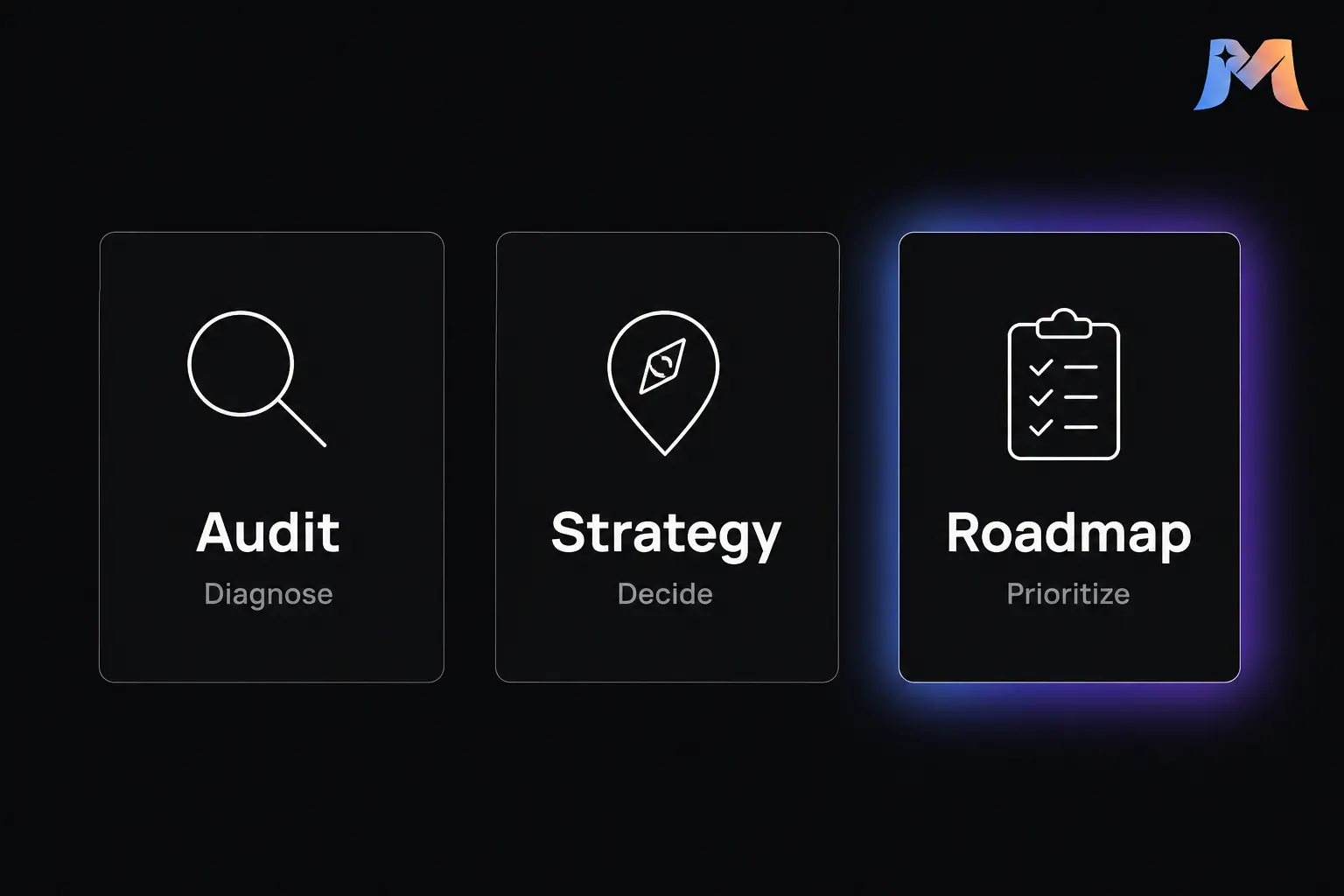
An SEO audit tells you what's happening on your website. An SEO strategy decides what you should do about it. And an SEO roadmap turns those decisions into a practical order of work.
So which one does your website actually need?
It depends on what's happening right now.
SEO Audit vs SEO Strategy
If you want the short version:
If you want to know... | You need... |
What's wrong with my website? | SEO Audit |
Why isn't my website performing? | SEO Audit |
Why did my traffic suddenly drop? | SEO Audit |
Which keywords and topics should we target? | SEO Strategy |
Which pages should we build or improve? | SEO Strategy |
How should SEO support the business? | SEO Strategy |
What should we work on first? | SEO Roadmap |
How do we actually improve the website? | SEO Execution |
In many cases, you need more than one.
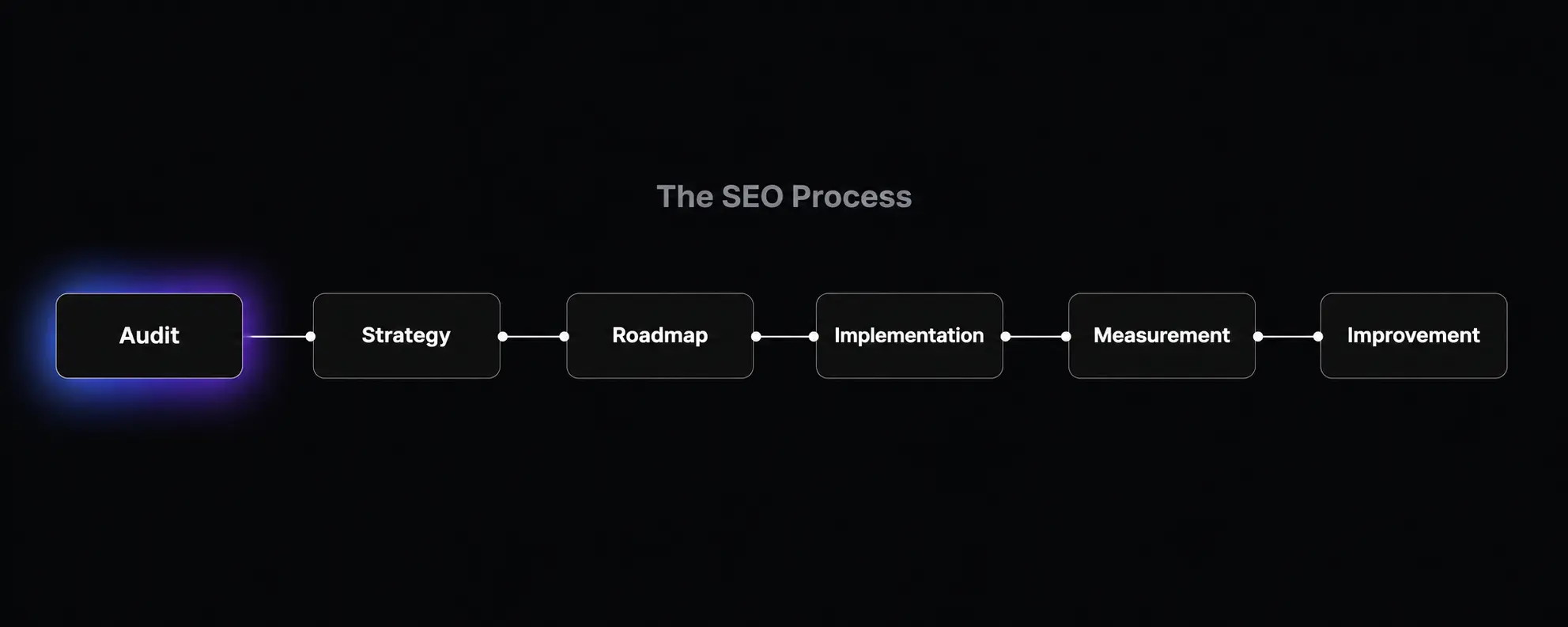
A typical process looks like this:
Audit → Strategy → Roadmap → Implementation → Measurement → Improvement
What Is an SEO Audit?
An SEO audit is essentially a diagnosis of your website.
You're trying to understand what's happening, what's working, what's holding the site back, and where there are opportunities to improve.
When I audit a website, I don't just look for errors because an SEO tool says they're there.
I want to understand whether those issues actually matter to the business.
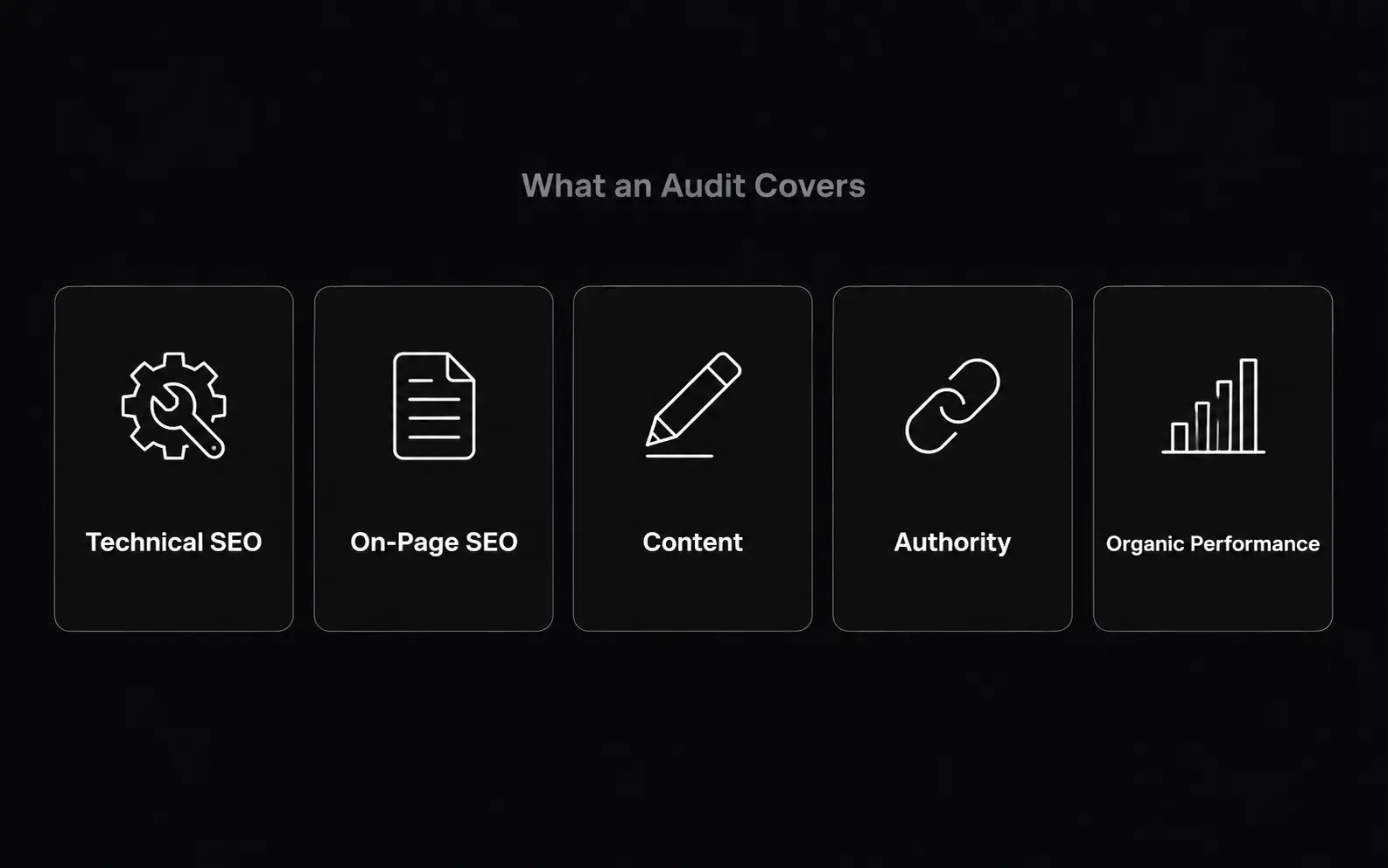
Depending on the website, an audit can cover things like:
Technical SEO
Crawling and indexing
Robots.txt
XML sitemaps
Canonicals
Redirects
Duplicate URLs
JavaScript rendering
Page speed and Core Web Vitals
Mobile usability
Structured data
Internal linking
Site architecture
If you want to see the technical side in more detail, I've also broken down how I approach a technical SEO audit, including the checks I make around crawling, indexation, redirects, canonicals and site architecture.
On-Page SEO
Title tags
Meta descriptions
H1s and headings
Search intent
Keyword targeting
Content quality
Internal links
Content overlap
Page relevance
This is where on-page and content SEO comes into the picture. The goal isn't to add keywords to a page for the sake of it. It's to make sure the right page is targeting the right search intent and that the rest of the site supports it.
Content
I look at whether the content actually deserves to rank for the searches it's targeting.
For example, an e-commerce website might have hundreds of blog posts but very weak category pages.
A SaaS website might have plenty of traffic from informational searches but almost no content targeting people who are actually evaluating or buying a solution.
Those aren't necessarily technical problems.
They're strategic problems.
Authority
I'll also look at things such as:
Backlink quality
Referring domains
Link relevance
Competitor authority
Digital PR opportunities
Internal authority distribution
Organic Performance
This is where tools like Google Search Console become particularly useful.
I want to understand:
Which pages are getting impressions?
Which pages are actually getting clicks?
Where are rankings declining?
Which queries are driving traffic?
Are important pages being ignored by Google?
Are rankings improving but leads aren't?
Has something changed recently?
The important part is connecting the data.
An audit isn't useful simply because it contains 200 issues.
It's useful when you understand which issues matter and why.
What Does an SEO Audit Actually Give You?
A proper audit should give you more than a list of errors.
Ideally, you should understand:
What is happening → Why it matters → What needs to change → How important it is → What should happen next
For example:
Your category pages aren't ranking.
That's an observation.
A useful audit goes further.
Maybe those category pages have very little unique content, weak internal links, poor search intent alignment, and most of the site's internal authority is going to blog posts.
Now you have a much better understanding of the problem.
And that leads us to an important point.
What an SEO Audit Won't Tell You
An audit can tell you what's wrong.
It doesn't automatically tell you what the business should prioritize.
Imagine an e-commerce website selling clothing.
The audit finds:
150 pages with thin content
80 duplicate title tags
Poor internal linking
Several indexation issues
Slow product pages
Weak category pages
All of those things may be real.
But should you fix all 150 thin pages before doing anything else?
Not necessarily.
What if the company's most profitable category has almost no organic visibility?
What if competitors are ranking for high-value searches that the website hasn't even targeted?
What if improving that category could generate significantly more business than fixing dozens of low-value pages?
That's where strategy comes in.
The audit identifies the problems.
Strategy decides what deserves attention first.
What Is an SEO Strategy?
An SEO strategy is the direction you choose for organic growth.
It's where the findings from an audit are turned into decisions about what to prioritize, which searches to pursue, which pages to build or improve, and how SEO should support the business.
If you want to see how I structure this in practice, my SEO Audit & Strategy covers the diagnostic work as well as the prioritized roadmap that comes after it.
A proper SEO strategy considers things like:
Business Goals
What are we actually trying to achieve?
More:
Leads?
Product sales?
Demo requests?
Qualified traffic?
Local customers?
Brand visibility?
Market share?
SEO shouldn't operate separately from the business.
Audience and Search Intent
Who are we trying to reach?
And more importantly:
What are they searching for at different stages of the buying journey?
For a SaaS company, for example, someone searching:
"What is project management software?"
has a very different intent from someone searching:
"Best project management software for remote teams"
And that's different again from:
"Asana alternatives"
Those searches might all be valuable, but they shouldn't necessarily be treated the same way.
Keyword and Topic Priorities
This is where keyword research becomes useful.
But a strategy isn't simply a spreadsheet containing 5,000 keywords.
You need to decide:
Which topics matter?
Which keywords have business value?
Which ones are realistic?
Which pages should target them?
What should be prioritized now?
What can wait?
Page Strategy
You need to determine what the website actually needs.
For example:
New category pages
Product pages
Service pages
Comparison pages
Location pages
Supporting content
Landing pages
A SaaS company might discover that it doesn't need 50 more generic blog posts.
It might need comparison pages, use-case pages, integration pages, and stronger product-led content.
That's a strategic decision.
Content Strategy
The question isn't:
"How many blogs should we publish every month?"
The better question is:
"What content should we create that supports the searches, pages, and business goals we're targeting?"
Sometimes that's 10 articles.
Sometimes it's 3.
Sometimes the best SEO decision is to stop publishing and improve what already exists.
Technical Priorities
Technical SEO is still important in strategy.
But you don't necessarily fix every technical issue simply because you found it.
You prioritize the problems that have the greatest potential impact.
This is also why I treat technical SEO as part of the bigger SEO picture rather than treating it as a standalone checklist.
Authority Strategy
You also need to decide:
Which pages need authority?
What type of links make sense?
Are there digital PR opportunities?
Which competitors have stronger authority?
Where are the biggest gaps?
Measurement
Finally, you need to know what success looks like.
That could mean:
Organic revenue
Qualified leads
Organic conversions
Rankings for important commercial terms
Non-branded traffic
Visibility in target markets
Not simply:
"We published 20 articles."
Keyword Research Isn't an SEO Strategy
This is something I see quite often.
Someone does keyword research, puts thousands of keywords into a spreadsheet and calls it an SEO strategy.
It's not.
Keyword research is an input into the strategy.
The strategy is what you do with that information.
For example, finding 500 keywords around "CRM software" doesn't tell you:
Which ones to target first
Which pages should target them
Whether you can realistically compete
What search intent Google is rewarding
How those pages should connect
Which searches have actual business value
That's the difference between research and decision-making.
SEO Audit vs SEO Strategy vs SEO Roadmap
There's another term that often gets mixed into this conversation: the SEO roadmap.
These three are related, but they're not interchangeable.
SEO Audit | SEO Strategy | SEO Roadmap | |
Main purpose | Diagnose | Decide | Prioritize |
Main question | What's happening? | What should we do? | What happens first? |
Focus | Problems & opportunities | Direction & priorities | Execution order |
Output | Findings | Strategic direction | Action plan |
Timeframe | Current state | Medium/long-term | Short/medium-term |
Think about it this way:
Audit: Here's what's wrong.
Strategy: Here's where we're going.
Roadmap: Here's what we're doing first.
Which One Does Your Website Actually Need?
This is probably the question you care about most.
Because you don't want to buy an SEO service just because someone told you that you need it.
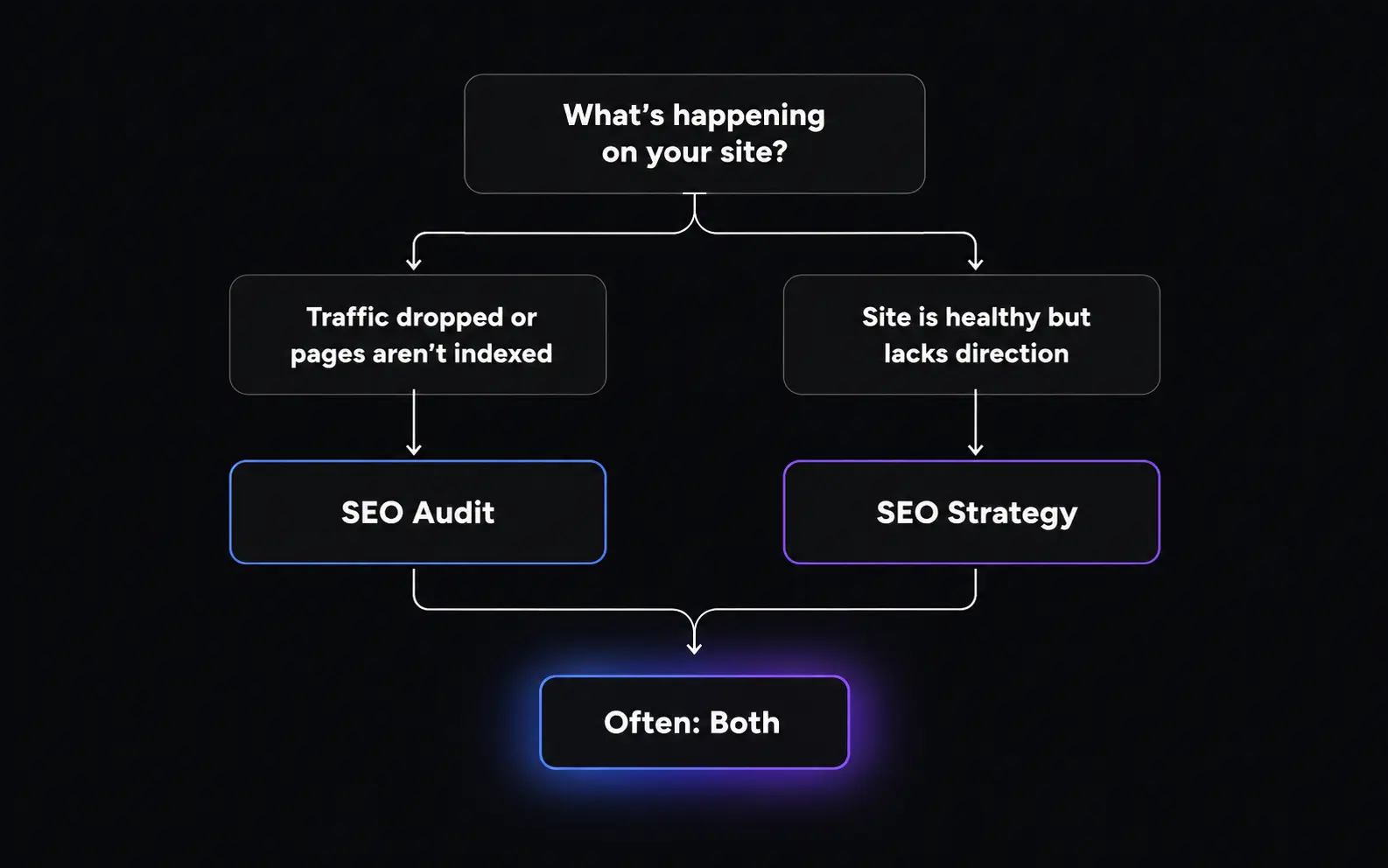
You probably need an SEO audit if:
Your organic traffic suddenly dropped
Your website isn't being indexed properly
You're not sure why pages aren't ranking
You recently redesigned or migrated the website
You have accumulated SEO problems over several years
Google isn't ranking important pages
You suspect technical issues
You're about to hire an SEO consultant and want an independent assessment
You've been doing SEO for months without knowing what's actually holding you back
An audit gives you a clearer picture of the current situation.
You probably need an SEO strategy if:
Your website is relatively healthy, but you don't know where to focus your SEO efforts.
For example:
You're launching a new website
You're entering a new market
You have a lot of content but no clear direction
You're targeting random keywords
Your traffic is growing but isn't generating business
You don't know which pages to build next
Your competitors are consistently taking visibility from you
Your SEO team is busy, but results aren't moving
In those cases, the problem might not be a broken website.
It might be a lack of direction.
Sometimes You Need Both
This is actually the most common situation.
You don't know what's wrong and you don't know what to do next.
That's when I'd normally start with an audit and use those findings to build the strategy.
Let's look at a few examples.
Example 1: An E-commerce Website With Lots of Traffic
Imagine an e-commerce website getting 30,000 organic visits every month.
Sounds good.
But most of the traffic is coming from blog posts.
The important product and category pages aren't generating much organic traffic.
An audit might reveal:
Weak category page content
Poor internal linking
Product pages competing with category pages
Duplicate content
Indexation problems
Weak topical structure
The audit tells us why the current site isn't performing as well as it could.
But the strategy needs to answer bigger questions:
Which product categories are commercially important?
Which searches should those categories target?
Which pages need to be rebuilt?
Which products deserve additional authority?
What supporting content should be created?
What should happen first?
That's audit + strategy + roadmap working together.
For larger stores, this becomes even more important because product, category, collection, and filtered URLs can create a completely different set of SEO challenges. That's why E-Commerce SEO needs to be approached differently from a small service website.
Example 2: A SaaS Company Publishing Content Every Week
Now imagine a software company publishing three blog posts every week.
After a year, they have hundreds of articles.
But organic growth has stalled.
The website isn't necessarily technically broken.
The problem might be that most of the content targets broad informational searches that don't have much connection to the product.
An audit can identify content overlap, weak internal linking, underperforming pages, and other issues.
But the bigger opportunity is strategic.
The company may need to shift toward:
Use-case searches
Comparison searches
Alternative searches
Integration-related searches
Product-led content
Commercial search intent
The answer isn't necessarily "publish more."
It might be:
"Publish less, but target better opportunities."
And once the core SEO strategy is right, there may also be opportunities to structure that content for AI-driven search and answer engines. That's where AI Search Visibility (GEO) can become another part of the strategy.
Example 3: A B2B Website Suddenly Loses Organic Traffic
Now take a B2B company that has been receiving consistent organic traffic for years.
One month, traffic drops by 40%.
That's not something I'd solve by immediately publishing more content.
I'd start with an audit.
I'd want to know:
Did important pages disappear?
Did URLs change?
Were redirects implemented correctly?
Did canonical tags change?
Are pages still indexable?
Did the website structure change?
Did rankings fall across the entire site or only certain sections?
Did competitors replace the site in the SERPs?
Did search demand change?
Once we understand what actually happened, we can decide what needs to be recovered and what needs to change.
That's the job of the audit.
A Good SEO Audit Isn't Just a List of Problems
This is one of the biggest differences between a useful audit and a report generated by an SEO tool.
You can run a website through Screaming Frog, Ahrefs, Semrush, or another platform and get hundreds of findings.
That doesn't automatically make it a good audit.
For important issues, I want to understand:
What is the issue?
Which pages are affected?
Why does it matter?
How much impact could it have?
How should it be fixed?
Does it need to be fixed now?
Are there dependencies?
For example, "duplicate title tags" isn't enough.
If 20 low-value pages have duplicate titles, that's one thing.
If your most important commercial pages are competing with each other because of poor targeting, that's something else entirely.
The context matters.
A Good SEO Strategy Isn't Just a Keyword Spreadsheet
The same principle applies to strategy.
If someone hands you a spreadsheet containing:
Keywords
Search volume
Keyword difficulty
Competitors
and calls that your SEO strategy, you're still missing most of the picture.
A useful strategy should connect those opportunities to:
Business goals
Search intent
Website architecture
Existing pages
New pages
Content
Internal linking
Technical priorities
Authority
Conversion opportunities
KPIs
Priorities over time
Most importantly, it should tell you what not to do.
That's often just as valuable.
The Biggest SEO Mistake: Confusing Activity With Strategy
I've seen businesses measure SEO by how much work is being done.
"10 blogs were published."
"30 backlinks were built."
"500 keywords were added."
"Every technical warning was fixed."
But activity isn't the same thing as progress.
Publishing 10 articles every month isn't a strategy.
Building 20 backlinks every month isn't a strategy.
Fixing every warning in an SEO crawler isn't a strategy.
Having a 500-keyword spreadsheet isn't a strategy.
Strategy is deciding which activities actually matter, why they matter, and in what order they should happen.
That's where good SEO becomes much more than a checklist.
How I Approach SEO Audits and Strategy
I don't like starting an SEO project by opening a checklist and working through it from top to bottom.
I first want to understand the website.
What does the business sell?
Who are they trying to reach?
Where does their revenue come from?
What has already been done?
What's currently working?
What's not?
Then I look at the data.
I use tools to find patterns, problems, and opportunities, but I don't treat tool recommendations as the final answer.
A tool can tell me that a page has an issue.
It can't always tell me whether fixing that issue should be the priority for the business.
That's the part that requires judgment.
That's also why I don't believe every website needs the same SEO strategy.
Two websites can sell similar products and still need completely different approaches.
If you want to see what this process looks like in practice, you can take a look at my SEO Audit & Strategy service.
What Happens After an SEO Audit?
An audit shouldn't be the end of the process.
It's the starting point.
A practical SEO process usually looks something like this:
1. Audit
Understand the current situation.
2. Strategy
Decide where the SEO effort should go.
3. Roadmap
Prioritize the work.
4. Implementation
Actually make the changes.
5. Measurement
Track what happened.
6. Improvement
Use the data to make the next decisions.
SEO isn't a one-time checklist.
The search landscape changes. Competitors change. Websites change. Businesses change.
Your strategy should be able to change with them.
No. An audit diagnoses the current state of the website, while a strategy determines what the business should focus on to achieve its SEO goals. You can think of it as: Audit = diagnosis Strategy = direction Roadmap = priorities
Usually, yes, especially if the website is already established. You want to understand the current situation before making major strategic decisions. However, a brand-new website may need strategic planning from the beginning rather than a traditional audit of an established site.
An audit itself doesn't improve rankings. It identifies problems and opportunities. The improvements happen when the findings are turned into prioritized actions and actually implemented.
No. Keyword research helps you understand what people search for. SEO strategy decides which opportunities are worth pursuing, which pages should target them, how they fit into the website, and how they support the business.
Not necessarily a full traditional audit. For a new website, I'd usually focus first on getting the technical foundation, architecture, search intent, page targeting and overall SEO strategy right. An audit becomes more useful once there's an established website and performance data to evaluate.
Ideally: Audit → Strategy → Roadmap → Implementation → Measurement The audit tells you what's happening. The strategy tells you what to focus on. The roadmap tells you what to do first.
You don't necessarily need to start by buying an SEO package. First, figure out what problem you're actually trying to solve. If your website has technical or performance issues, an audit may be the right starting point. If the website is healthy but your SEO efforts lack direction, you may need a strategy. And if you're dealing with both, the two should work together. That's how I approach SEO.
I don't start with a predefined package. I start by understanding what the website actually needs.
If you'd like me to look at your website and determine whether you need an SEO audit, an SEO strategy, or both, you can start with a free growth plan.
Ready to fix what's actually holding your site back?
I'll show you exactly what's costing you rankings and traffic, then build the plan to fix it.
Get a Free Strategy Call