
Your Website Ranks on Google. So Why Isn't AI Mentioning You?
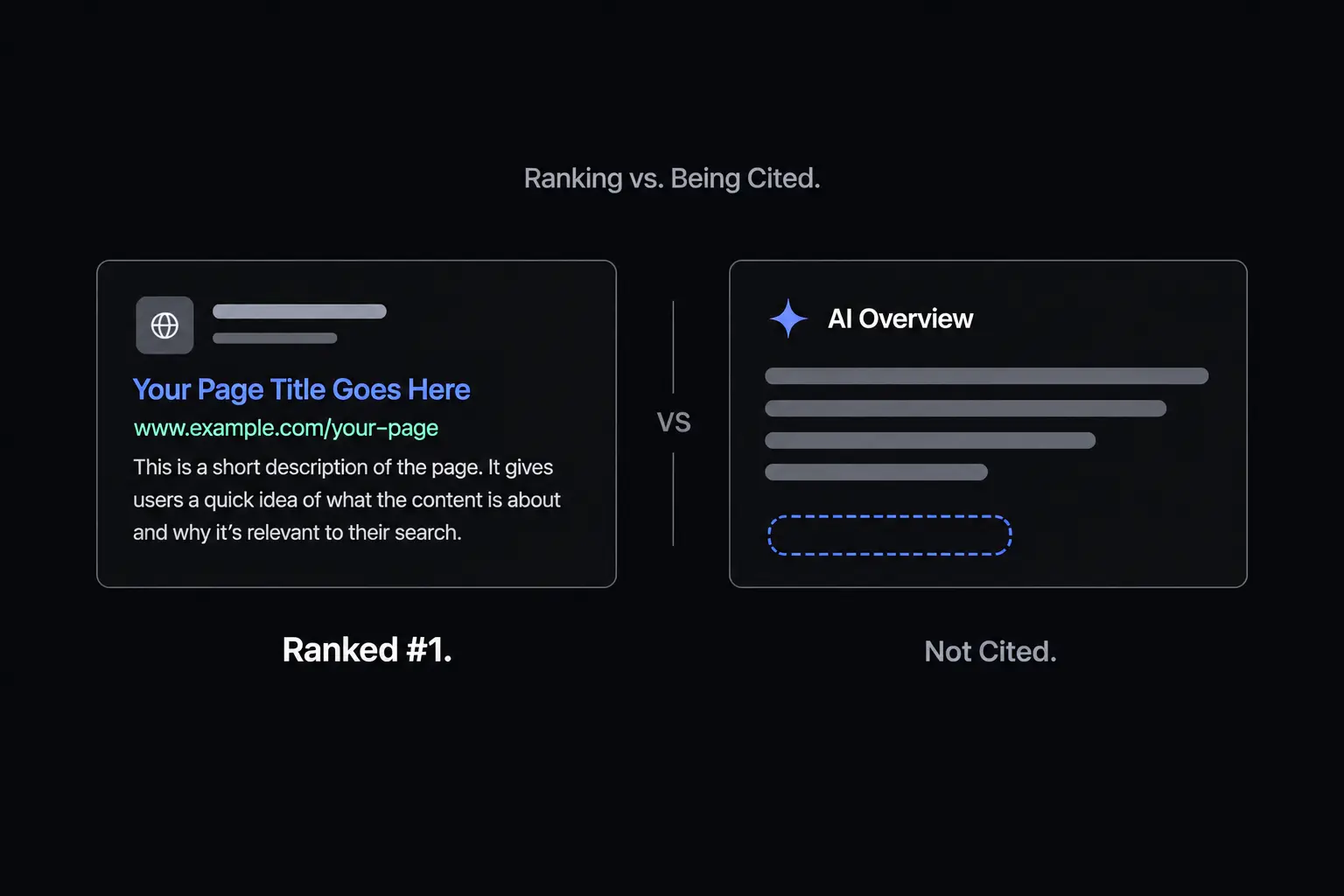
Your website ranks on Google.
Your important pages are indexed.
You are getting organic traffic.
But then you ask ChatGPT, Perplexity, or another AI search tool a question related to your business, and your website isn't mentioned.
Your competitor is.
This can be confusing.
If Google considers your website relevant enough to rank, why isn't an AI system using it as a source?
The answer is that Google rankings and AI visibility are related, but they are not the same thing.
Traditional search gives you a position in a list of results.
AI search can retrieve information from multiple sources, evaluate that information, and use selected sources to construct an answer. OpenAI's ChatGPT Search, for example, provides web sources and links with answers, while Bing now reports which URLs are being cited in supported AI experiences.
So if your website ranks on Google but doesn't appear in AI answers, I wouldn't immediately start rewriting the entire website.
I'd first find out where the visibility gap actually exists.
Google Ranking and AI Visibility Are Not the Same Thing
Imagine you rank #4 for:
best logistics company in Karachi
That's a useful SEO result.
But a customer might ask an AI system:
Which logistics companies in Karachi are suitable for international freight?
The system may retrieve information from several websites and produce a completely different set of sources.
Your position in Google's traditional results doesn't automatically determine whether your page will be selected as a source in an AI-generated answer.
Recent research into generative search also shows that different AI systems can differ substantially in the sources they retrieve and cite. The research is still developing, so I wouldn't treat any single GEO tactic as a universal ranking formula.
That's why I think about AI visibility differently.
Instead of asking:
"What position am I in AI search?"
I ask:
"Can the system find, understand, trust and use my content for the questions my customers are asking?"
Before You Fix Anything, Find Out Where You're Invisible
There are several different problems that can look like the same thing.
Your website could be:
inaccessible to a relevant crawler
indexed but poorly understood
ranking for the wrong queries
answering the wrong search intent
missing useful supporting information
lacking clear information about the business itself
weaker than the sources being selected
visible in one AI system but absent from another
So my first step would be to separate the problem.
I would look at AI visibility through this process:
Access → Entity → Retrieval → Relevance → Evidence → Authority → Citation
Let's go through each one.
1. Your Website May Not Be Accessible to the AI Search System
Before worrying about content, make sure the relevant system can actually access it.
For ChatGPT Search, OpenAI says websites that want their content to be discovered and surfaced in ChatGPT should not block OAI-SearchBot. It also notes that website owners need to make sure their host or CDN allows traffic from OpenAI's published searchbot IP addresses.
This doesn't mean:
"Allow every AI crawler and you'll start ranking."
It simply means that if you intentionally block a search crawler, you can create an obvious visibility problem.
What I check
robots.txt
noindex
canonical tags
HTTP status codes
CDN/firewall rules
bot protection
server errors
whether important content is actually accessible
Bing indexing
Google indexing
This is still technical SEO.
AI search hasn't made crawlability and indexability irrelevant.
Google's own guidance says its existing SEO fundamentals remain relevant for AI features in Search.
If you suspect technical problems, I'd start with a proper technical SEO audit, rather than trying to optimize the wording of every page.
2. AI May Not Clearly Understand Who Your Business Is
This is different from simply having an About page.
Think about your website from a machine's perspective.
Can it clearly determine:
Who is this business?
What does it sell?
Who does it serve?
Where does it operate?
What industry is it part of?
What services does it provide?
Who is behind the business?
What evidence exists about it elsewhere?
For example, imagine two websites.
Website A
We are the best digital marketing company providing world-class solutions.
Website B
We help B2B manufacturers in Pakistan generate international leads through SEO and search marketing. Our team works with manufacturers targeting buyers in the US, UK and Europe.
The second gives much more useful context.
That doesn't mean a paragraph like this automatically gets a website cited.
It means you've made the entity and its relevance much clearer.
What I would check
Brand name consistency
About page
Organization or Person information where appropriate
Service descriptions
Author information
Contact information
Location information where relevant
Social profiles
Third-party mentions
Business directories where appropriate
Consistency across the web
And one important point:
Schema isn't a magic AI visibility switch.
Use structured data where it accurately represents the page and entity. Don't add random schema hoping it will force an AI system to cite you.
3. Your Page May Discuss the Topic Without Actually Answering the Question
This is one of the biggest content problems I see.
A page can be completely relevant to a topic and still be difficult to use as a source.
For example, someone asks:
How much does SEO cost for a small business?
A weak answer might begin with three paragraphs about how important digital marketing is.
A stronger answer gets to the point:
SEO costs vary based on competition, market, website size and the amount of work required. A local business targeting a small geographic area will usually have very different SEO requirements than a national e-commerce website.
Then the page can explain the details.
When I review content, I ask:
Does the page answer the main question directly?
Are important answers buried?
Are headings clear?
Can individual sections be understood on their own?
Are claims specific?
Are examples included?
Does the page cover the obvious follow-up questions?
This doesn't mean turning every page into a collection of short AI-friendly answers.
It means making the content clear enough for both people and search systems to understand.
4. You Have Content, But You Don't Have First-Hand Evidence
This is where many websites become interchangeable.
Search for a competitive topic, and you'll often find ten pages saying roughly the same thing.
Same definitions.
Same advice.
Same examples.
Same conclusions.
If your page doesn't add anything beyond what everyone else already says, there's less reason for someone to use it as a source.
This is why I like adding things such as:
original observations
real examples
screenshots
data
tests
case studies
actual processes
lessons from projects
original comparisons
explanations of what went wrong
For example:
"I audited a website where more than half of the important pages weren't being indexed."
is more useful than:
"Indexing problems are common."
The first statement gives the reader an actual experience.
Google's current guidance for AI features also emphasizes unique, valuable content rather than content created primarily to manipulate search visibility.
That's an important distinction.
Don't write for AI at the expense of humans.
Write something worth retrieving.
5. Your Competitor May Have More Evidence Around Them
Sometimes your page is good.
Your competitor's page is also good.
The difference is that there is simply more information supporting the competitor across the wider web.
For example:
industry publications
interviews
reviews
partnerships
expert contributions
case studies
reputable references
original research
relevant mentions
This is particularly interesting in AI search.
A 2025 GEO study found that the AI search systems it tested showed a strong tendency toward earned, third-party sources compared with brand-owned and social content. That is research evidence, not a universal rule for every AI system, but it highlights why external recognition can matter.
So if an AI answer keeps mentioning your competitor, don't only compare your two websites.
Compare the evidence around both businesses.
Ask:
What does the web say about them that it doesn't say about me?
That question can reveal a much bigger gap.
6. You're Treating AI Search as One Platform
There isn't one universal "AI ranking."
Your visibility can differ between:
Google AI Overviews
Google AI Mode
ChatGPT Search
Microsoft Copilot
Perplexity
The systems can use different retrieval infrastructure and produce different answers.
Bing's current AI Performance reporting makes this especially clear by showing citation activity across supported Microsoft AI experiences, including which URLs are referenced and which grounding queries are associated with those citations.
So don't run one prompt in ChatGPT and conclude:
"My website isn't visible in AI."
That's too broad.
7. Your Website May Be Ranking for the Wrong Queries
This connects directly to traditional SEO.
Imagine an SEO consultant ranking for:
what is SEO
But the business actually wants customers searching:
SEO consultant for SaaS companies
The website might have strong visibility for informational searches while remaining almost invisible for commercial questions.
That's why I would build an AI query set based on actual customer intent.
Informational
What is technical SEO?
Problem-based
Why is my website losing organic traffic?
Commercial investigation
How do I choose an SEO consultant?
Comparison
SEO agency vs freelancer for a small business
Transactional
SEO consultant for e-commerce businesses
The goal isn't to manufacture hundreds of question variations.
It's to understand the questions that actually matter to the business.
8. Your Internal Architecture May Not Make the Topic Relationship Clear
A single page rarely explains everything.
A strong website usually has relationships between pages.
For example:
Homepage
↓
SEO service
↓
Technical SEO article
↓
Technical SEO audit article
↓
Case study
↓
Related service
This helps search engines understand the broader topic and relationship between your pages.
Your internal links should therefore be intentional.
Don't add:
"Click here to read more."
Instead, link meaningful phrases where they naturally belong.
For example:
If you're dealing with crawlability, indexation or canonical problems, start with a technical SEO audit before changing the site's content.
And when discussing content problems:
If the technical foundation is healthy, the next step is usually looking at On-Page & Content SEO, search intent and how well the page answers the query.
9. Technical SEO Still Matters
AI search hasn't replaced technical SEO.
If Google can't properly crawl, index or understand your pages, that's already a problem for traditional search.
And if a relevant AI search system can't access or retrieve the content, you have another visibility problem.
I would check:
Crawlability
Indexability
Canonicals
Robots.txt
Status codes
Redirects
JavaScript rendering
Duplicate URLs
Internal links
XML sitemap
Important content accessibility
Google's current documentation continues to point site owners toward foundational SEO practices when optimizing for its generative AI search features.
So I wouldn't build a separate "AI technical SEO" checklist full of hacks.
Fix the fundamentals first.
Does Schema Markup Make AI Cite Your Website?
This is one of the questions I see frequently.
The short answer is:
No, schema markup isn't a guarantee that an AI system will cite your website.
Structured data can help search engines understand eligible content and entities when implemented correctly.
But adding Organization, FAQ or other schema doesn't mean:
"AI will now mention my business."
Google's current AI search guidance does not require special structured data specifically for AI features.
So I use schema to accurately describe the page.
I don't use it as a shortcut around content quality, relevance or authority.
Do You Need llms.txt to Appear in AI Answers?
There's a lot of confusion around this.
For Google Search, you should not treat llms.txt as a requirement for appearing in AI features.
Google's current guidance focuses on its existing Search fundamentals rather than requiring a special llms.txt file. Its documentation updates have also clarified that generative AI features remain subject to Google's normal Search policies and systems.
So if someone tells you:
"Just add llms.txt and your website will start appearing in ChatGPT and Google AI."
I'd be very cautious.
AI search is not that simple.
How I Would Actually Audit AI Search Visibility
This is the process I'd use before changing a client's website.
Step 1: Build a list of important questions
Start with around 10 to 30 questions customers could realistically ask.
Don't generate 500 variations just for the sake of having more queries.
Step 2: Check traditional Google visibility
Record:
ranking URL
position
impressions
clicks
search intent
competing pages
This establishes your traditional search baseline.
Step 3: Test the same questions across AI search
Where relevant, check:
Google AI features
ChatGPT Search
Perplexity
Copilot
Record whether the business is:
Mentioned → Cited → Not present
Step 4: Record who gets cited instead
This is extremely important.
Don't just write:
"We're not appearing."
Record:
"Competitor X is being cited."
Then inspect the cited page.
Step 5: Compare the pages
Look at:
topical relevance
answer clarity
depth
first-hand information
original data
structure
freshness
internal architecture
external references
entity clarity
You're now comparing evidence, rather than guessing.
Step 6: Check technical access
Verify:
robots.txt
indexation
canonical
HTTP status
crawler access
Bing indexing
important page accessibility
For ChatGPT specifically, check whether OAI-SearchBot is unintentionally blocked.
Step 7: Fix the actual gap
If the problem is technical:
Fix technical SEO.
If it's relevance:
Improve search intent and topical alignment.
If it's content:
Add useful information and first-hand evidence.
If it's entity clarity:
Make the business and its expertise clearer.
If it's authority:
Build genuine recognition and relevant third-party evidence.
If the page is already strong:
Keep testing and measuring rather than endlessly rewriting it.
A Simple Framework I Use for AI Visibility
When I look at why a website isn't appearing in AI answers, I think about seven questions:
1. Access
Can the relevant systems access the content?
2. Entity
Is it clear who the business or author is?
3. Retrieval
Can the relevant page be discovered for the question?
4. Relevance
Does the page actually answer the question?
5. Evidence
Does it provide useful, original or verifiable information?
6. Authority
Is there credible evidence supporting the business and its expertise?
7. Citation
Is the system actually selecting and referencing the page?
This is much more useful than asking:
"What GEO trick should I use?"
Because there isn't one trick.
Why Your Competitor Appears and You Don't
Let's say you rank #5 on Google.
Your competitor ranks #9.
You might naturally think:
"I should be the one appearing in the AI answer."
Not necessarily.
The competitor may have:
a clearer answer
stronger supporting evidence
better topical coverage
more first-hand information
stronger external references
clearer entity information
better coverage of the exact question
Or the particular AI system may simply retrieve a different set of sources.
That's why I wouldn't start by asking:
"Why didn't AI pick me?"
I'd ask:
"What did AI use instead, and what does that source provide that mine doesn't?"
That's where the useful SEO work begins.
How to Improve AI Search Visibility Without Abandoning SEO
You don't need to create one website for Google and another website for AI.
Your foundation should still be good SEO:
crawlable pages
indexable content
clear site architecture
strong internal linking
relevant content
useful titles and headings
good user experience
original information
trustworthy authorship
genuine authority
Then build on that with content that is easy to understand, specific, useful and supported by evidence.
This aligns with Google's current position that its existing SEO practices remain foundational for AI features.
And as AI search evolves, measurement becomes increasingly important.
Bing's AI Performance tools now let site owners see citation counts, cited pages and grounding queries for supported AI experiences.
That means we can increasingly move from:
"I think my website is visible in AI."
to:
"Here are the queries, pages and AI experiences where my website is actually being cited."
That's a much better way to approach GEO.
What I Would Fix First
If I found that a website ranks well on Google but has almost no AI visibility, I wouldn't make 20 changes at once.
I'd prioritize them.
Problem: Crawler or accessibility issue
Fix: Technical access first.
Problem: Page isn't indexed properly
Fix: Resolve indexation, canonical and crawl issues.
Problem: Wrong search intent
Fix: Rework the page around the actual customer question.
Problem: Generic content
Fix: Add original information, examples, experience and evidence.
Problem: Weak entity clarity
Fix: Make the business, people, services and expertise clearer across relevant pages and external sources.
Problem: Competitors have stronger external evidence
Fix: Work on legitimate digital PR, partnerships, expert contributions and original research.
Problem: No measurable AI visibility
Fix: Build a repeatable query set and track mentions, citations and cited URLs across relevant AI platforms.
Don't Try to "Optimize for AI" Before You Understand the Problem
This is probably the biggest lesson I'd take from all of this.
If your website doesn't appear in an AI answer, the solution isn't automatically:
more content
more FAQs
more schema
llms.txt
more keywords
more backlinks
shorter paragraphs
"AI-optimized" writing
Any of those could be useful in the right situation.
But first you need to know which problem you're actually solving.
AI search is developing quickly, and current research describes it as a multi-stage process involving discovery, retrieval, reranking, citation and how information is ultimately used in an answer. There is still considerable variation between systems, so I would avoid promising a fixed formula for getting cited everywhere.
The better approach is:
Measure → Diagnose → Fix → Test → Measure again.
That's how I'd approach AI visibility today.
Final Thought
If your website ranks on Google but your competitor keeps appearing in AI answers, don't immediately assume your SEO is broken.
And don't start changing everything.
Find the gap first.
Can the system access your content?
Does it understand your business?
Can it retrieve the right page?
Does that page answer the question clearly?
Does it provide something genuinely useful?
Is there evidence supporting your expertise?
And most importantly:
What sources are being cited instead of you?
Once you know that, AI search optimization becomes much less mysterious.
It becomes another problem you can investigate, test and improve.
Frequently Asked Questions
Google rankings don't guarantee inclusion in ChatGPT answers. ChatGPT Search uses web search and selects sources based on the query and its retrieval process. Website owners who want their content to be discoverable in ChatGPT should also make sure they aren't unintentionally blocking OAI-SearchBot.
No. A page can rank in traditional Google results without being selected as a source in an AI-generated answer.
You should understand how the different systems work, but you don't need completely separate SEO strategies. Strong technical SEO, useful content, clear information and genuine authority remain important foundations.
Accurate structured data can help search engines understand eligible content, but schema isn't a guarantee of AI citation and shouldn't replace content quality or authority.
You shouldn't treat llms.txt as a requirement for Google AI features. Google's current guidance focuses on established Search fundamentals rather than a special llms.txt requirement.
Build a set of important customer queries, test them across relevant AI search systems, record whether you're mentioned or cited, identify which URLs and competitors appear, and compare the sources being used. Bing Webmaster Tools also now provides AI citation reporting for supported Microsoft AI experiences.
Need help finding the gap?
If your website is getting Google traffic but isn't showing up when potential customers search through AI, I can audit the technical foundation, content, search intent, entity signals, AI accessibility and competitor coverage to identify where the visibility gap actually exists.
Get a Free Strategy Call