
When someone searches Google for “SEO audit,” “what is technical SEO,” or “best SEO agency,” they are not necessarily looking for the same thing.
The words in the search query tell you what someone typed.
Search intent helps you understand what they actually want to find.
That difference matters because you can target the right keyword, write a well-optimized page, build links to it, and still struggle to rank if the page doesn't match what searchers expect.
When I work on an SEO strategy, I don't decide which page to create from keyword volume alone. I look at the search results, understand what Google is showing for the query, identify the underlying intent, and then decide what type of page makes sense.
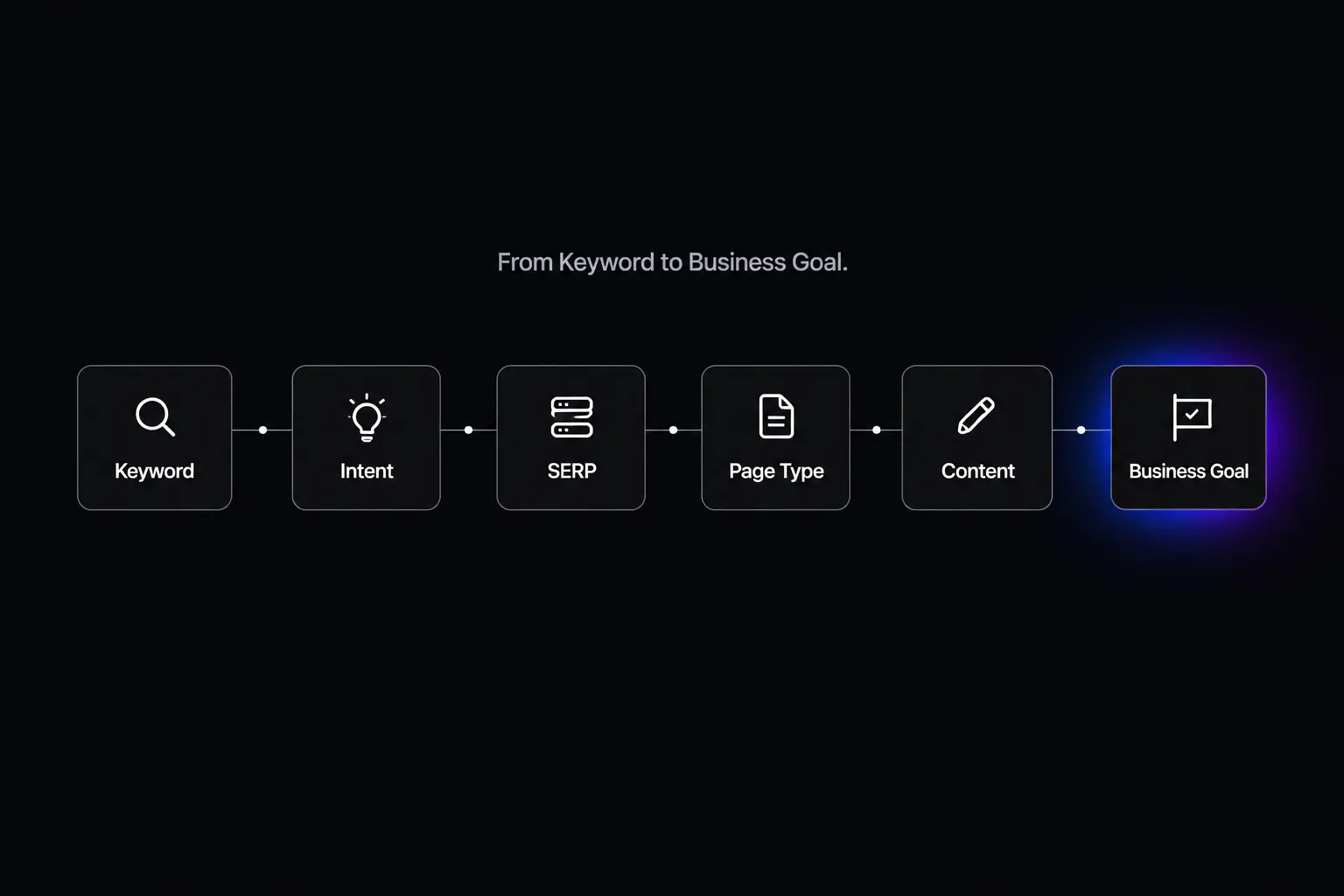
A simple way to think about it is:
Keyword → Intent → SERP → Page Type → Content → Business Goal
Let's break that down.
What Is Search Intent?
Search intent is the goal behind a person's search query: what they are trying to learn, find, compare, or do when they search.
It is also commonly called user intent.
For example:
“what is technical SEO” → the person wants to learn
“Ahrefs login” → the person wants to reach a specific website
“best SEO tools” → the person is researching options
“SEO audit service” → the person may be looking for a service
These queries are all related to SEO, but the person behind each search has a different need.
That means the right page for one query may be completely wrong for another.
Keyword vs. search intent
This distinction is important.
A keyword is the phrase someone searches.
Search intent is the reason behind that search.
For example, take the keyword:
“technical SEO”
The person searching it could be looking for:
a definition
a technical SEO checklist
technical SEO services
a technical SEO consultant
a technical SEO course
examples of technical SEO problems
The keyword alone doesn't tell you which one they want.
The search results give you additional evidence.
That's why I don't treat a keyword tool's intent label as the final answer. It can help organize research, but when I'm deciding what page to create, I want to see what is actually appearing in Google.
Why Does Search Intent Matter for SEO?
Because SEO isn't just about getting a keyword onto a page.
The page needs to be relevant to what the searcher is trying to accomplish.
Imagine someone searches:
“SEO audit service”
You create a 3,000-word article explaining:
What Is an SEO Audit?
The article could be genuinely useful and well written.
But if the SERP is dominated by SEO audit service pages, agencies, and commercial landing pages, your informational article may not be the best match for the query.
The problem isn't necessarily your writing.
It could be a page-intent mismatch.
This is one reason search intent is an important part of an SEO Audit & Strategy. Before creating more content, I want to know whether the website already has the right page targeting the right search.
Search intent also influences:
keyword mapping
content strategy
page architecture
internal linking
on-page optimization
content creation
conversion strategy
cannibalization analysis
I think about it this way:
Don't ask only, “Can I rank for this keyword?”
Ask, “What does a searcher expect to see after typing this keyword?”
That question can completely change the SEO strategy.
The 4 Types of Search Intent
There are four commonly used search-intent categories:
Informational
Navigational
Commercial investigation
Transactional
They are useful as a starting framework, but don't treat them as rigid boxes.
Some searches have mixed intent, and the actual SERP is often more useful than the label.
1. Informational Search Intent
The searcher wants to learn something or find an answer.
Examples:
what is SEO
what is search intent
how does technical SEO work
how to improve website speed
why is my website not ranking
SEO checklist
The person isn't necessarily ready to buy anything.
They're trying to understand a topic, solve a problem, or research something.
Typical page types
Informational searches often produce:
blog posts
guides
tutorials
documentation
videos
educational resources
For example, someone searching:
“what is search intent”
probably expects an explanation rather than a service page asking them to book an SEO consultation.
Does informational traffic have business value?
It can.
Informational content can help you:
build topical authority
answer questions potential customers have
demonstrate expertise
introduce users to your business
create internal links to commercial pages
attract users earlier in the buying journey
But I wouldn't publish an article simply because a keyword has search volume.
I'd ask:
Does this topic attract the type of audience I want to build authority with?
That's an important distinction between publishing content for traffic and building content as part of an actual SEO strategy.
2. Navigational Search Intent
The searcher wants to find a specific website, brand, person, or page.
Examples:
Ahrefs login
YouTube
Google Search Console
Nike website
Semrush pricing
The user already knows where they want to go.
They're essentially using Google as a navigation tool.
For example:
“Google Search Console”
has a different intent from:
“how to use Google Search Console.”
The first is primarily navigational.
The second is informational.
That difference matters when deciding which URL should target each query.
3. Commercial Investigation Intent
The searcher is researching options before making a decision.
Examples:
best SEO tools
best SEO agency in Karachi
Ahrefs vs Semrush
best CRM for small business
Shopify vs WooCommerce
SEO agency reviews
The person may not be ready to buy immediately.
But they're getting closer to making a commercial decision.
They might be comparing:
products
services
companies
features
pricing
reviews
alternatives
Typical content
You may see:
comparison pages
reviews
“best” lists
alternatives pages
buying guides
service comparison pages
This intent can be particularly valuable because the searcher is already evaluating possible solutions.
4. Transactional Search Intent
The searcher is ready to take an action.
That could mean:
buying something
booking something
signing up
requesting a quote
contacting a business
ordering a product
Examples:
buy running shoes
SEO consultant Karachi
SEO audit service
book dentist appointment
HubSpot pricing
order flowers online
Typical page types
Transactional searches often produce:
product pages
category pages
service pages
booking pages
pricing pages
signup pages
lead-generation landing pages
For example, someone searching “SEO audit service” is likely to need a very different experience from someone searching “what is an SEO audit?”
The topic is similar.
The intent isn't.
Search Intent Isn't Always Clear-Cut
This is where many people make a mistake.
They learn the four categories and then try to force every keyword into exactly one.
Real searches aren't always that clean.
Consider:
“SEO tools”
Someone could be looking for:
a definition
a list of tools
recommendations
pricing
comparisons
a tool they can use immediately
So the keyword itself doesn't provide the complete answer.
Some queries have mixed intent.
You may see several different page types ranking on the same SERP.
That's why I use the four categories as a starting framework, not as the final decision.
The SERP is the evidence.
How to Determine Search Intent for Any Keyword
This is the part that matters most when you're actually doing SEO.
When I'm deciding which page should target a keyword, I use a simple process.
Step 1: Search the Keyword
Search the exact query in Google.
Don't immediately start writing.
First, look at what Google is showing.
Step 2: Analyze the Top Results
Study the first page.
Ask:
What type of websites are ranking?
What type of pages are ranking?
Are they mostly blogs?
Service pages?
Product pages?
Category pages?
Comparison pages?
Videos?
Forums?
Official websites?
You're looking for a pattern.
If eight of the top ten organic results are service pages, that's strong evidence that Google is interpreting the query commercially.
It doesn't mean a different page type can never rank.
It means you now understand the environment you're competing in.
Step 3: Identify the Dominant Page Type
This is one of the most important parts of intent analysis.
Let's say you want to target:
“SEO audit service”
If most results are service pages or landing pages, creating another educational blog post called:
“What Is an SEO Audit?”
may be targeting a different intent.
Instead, you may need a proper commercial page explaining:
what the audit includes
what problems you identify
how the process works
what the client receives
who the service is for
why an audit matters
how to start
The page type should fit the search.
This also connects directly with On-Page & Content SEO. Optimizing a page isn't just about changing title tags or adding keywords. The page itself needs to satisfy the underlying search.
Step 4: Look at the Content Format
Now ask:
What format dominates the results?
For informational searches, you might see:
how-to guides
step-by-step tutorials
list posts
detailed explainers
comparisons
reviews
For example:
“how to fix broken links”
will generally make more sense as a practical guide than a generic article about why broken links are bad.
The format should help the searcher accomplish what they came to Google to do.
Step 5: Identify the Content Angle
This is often overlooked.
Two pages can cover the same topic but approach it differently.
Suppose you search:
“best SEO tools”
You might notice that ranking pages emphasize:
tools for beginners
tools for agencies
technical SEO tools
free tools
tools for 2026
all-in-one platforms
The dominant angle tells you something about what searchers may value.
It can also reveal opportunities.
If every result is generic, there may be an opportunity to provide something more useful based on genuine experience.
But don't create a different angle just to be different.
The angle still needs to satisfy the searcher's underlying need.
Step 6: Check SERP Features
The organic blue links aren't the entire SERP.
Look for:
featured snippets
People Also Ask
videos
images
local results
product results
discussions
AI search features
related searches
These features can provide additional clues about the query.
For example, a query producing mostly local results tells you something very different from one producing mostly educational articles.
Step 7: Check for Mixed Intent
Now ask:
Is one intent clearly dominant, or is the SERP split?
You might find:
5 informational pages
3 commercial pages
2 category pages
That's a mixed SERP.
In that situation, don't pretend there is one absolute answer.
Look at:
which page types dominate
which results occupy the strongest positions
what your website is capable of producing
what makes sense for the business
whether multiple needs can be satisfied on one page
Sometimes the right answer is one comprehensive page.
Sometimes separate pages make more sense.
Step 8: Decide Which Page Should Target the Keyword
Only after doing the above should you decide:
What URL should target this query?
For example:
Keyword | Likely intent | Suitable page |
|---|---|---|
what is technical SEO | Informational | Blog/guide |
technical SEO checklist | Informational | Detailed guide |
best SEO tools | Commercial investigation | Comparison/list |
SEO consultant Karachi | Transactional | Service/location page |
SEO audit service | Transactional | Service page |
Ahrefs login | Navigational | Official/login page |
These aren't permanent rules.
The actual SERP should always be checked before making the final decision.
The SERP Is Your Best Search Intent Tool
Keyword tools are useful.
They can classify thousands of keywords quickly and help organize a large keyword set.
But when I'm deciding what page to build, I still want to inspect Google.
Why?
Because the SERP shows what Google is currently returning for that query.
For example, imagine you have this keyword:
“SEO services”
A keyword tool might tell you it has commercial or transactional intent.
Useful.
But I still want to search it.
If I see:
SEO agencies
SEO service pages
agency landing pages
service directories
I have stronger evidence about what type of page I'm competing with.
Now compare that with:
“how does SEO work?”
If the results are dominated by:
educational articles
guides
explainers
videos
then the page requirement is completely different.
So my approach is:
Keyword classification helps organize the research.
SERP analysis helps make the page decision.
Search Intent Determines the Page You Should Create
One of the most expensive SEO mistakes is creating the wrong page.
Here's a simple example.
You have an SEO agency.
You want to rank for:
“SEO services”
You create a 3,500-word article:
“The Complete Guide to SEO Services”
You optimize the title.
Add headings.
Add keywords.
Build backlinks.
Months later, it still struggles.
One possible reason?
You built a blog article for a service query.
If the SERP is predominantly commercial service pages, Google is giving you a clue about what users are looking for.
A dedicated service page may be more appropriate.
Now consider:
“what does an SEO agency do?”
That may be much more informational.
A detailed article could make more sense.
Same broad topic.
Different search intent.
Different page.
Search Intent and Keyword Mapping
This is where search intent becomes particularly useful for larger websites.
I don't want 20 keywords randomly assigned to 20 URLs.
I want to understand the relationship between:
Keyword → Intent → URL → Content
For example:
Keyword | Intent | Target URL |
|---|---|---|
what is technical SEO | Informational | Blog/guide |
technical SEO checklist | Informational | Technical SEO checklist |
technical SEO services | Transactional |
|
SEO audit | Commercial/Transactional |
|
SEO audit checklist | Informational | Audit checklist |
Not every related keyword needs its own page.
But not every keyword should be forced onto the same page either.
Intent helps you decide where the boundaries should be.
This becomes even more important when you're dealing with a large site containing service pages, location pages, category pages and dozens or hundreds of articles.
Search Intent and Keyword Cannibalization
Search intent is also useful when investigating potential keyword cannibalization.
Suppose two pages on your website rank for the same keyword.
Does that automatically mean you have a cannibalization problem?
No.
Two URLs appearing for the same query isn't automatically a problem.
The more important question is whether the pages have overlapping purposes and whether that overlap is actually hurting organic performance.
For example:
one page explains a topic
another page offers a service
another page compares solutions
These pages may have different purposes even when their keywords overlap.
So I wouldn't automatically 301 the weaker URL.
I'd check:
What is each page's intent?
Which queries does each page actually receive?
Which URL gets impressions and clicks?
Are they targeting the same search intent?
Are they competing with each other?
Does either page have a stronger purpose?
Would merging improve relevance?
Would redirecting remove useful long-tail visibility?
The goal isn't to eliminate every instance of keyword overlap.
The goal is to create a clear page-to-intent architecture.
Search Intent and Internal Linking
Search intent also affects how I think about internal links.
Internal linking isn't just about placing a link because two articles contain similar words.
The link should make sense for the user's next step.
For example, someone reading an article about search intent may naturally want to understand:
why their website isn't ranking
how on-page SEO works
how to conduct an SEO audit
how AI search visibility differs from traditional Google search
That's why I would connect this article with resources such as my guide on why a website isn't ranking on Google, my On-Page & Content SEO service, and my SEO Audit & Strategy page.
The relationship between the pages matters more than simply increasing the number of internal links.
Does Search Intent Matter for AI Search?
Yes, but I wouldn't treat AI search as simply another version of the four traditional intent categories.
People increasingly use longer and more conversational queries when interacting with search and AI systems.
For example:
“What should I fix first if my e-commerce website gets traffic but very few sales?”
That's much more specific than:
“e-commerce SEO”
The underlying need still matters.
The system needs to understand:
what the person is asking
what problem they're trying to solve
what information would satisfy them
which sources contain useful evidence
This is one reason I think search intent remains important as search interfaces change.
However, matching search intent doesn't guarantee an AI citation or Google ranking.
AI search visibility involves much more than intent.
I also look at:
technical accessibility
clear entities
useful original content
first-hand evidence
internal architecture
external authority
structured data where appropriate
whether the page actually answers the question
I've covered the difference between traditional Google visibility and AI visibility in Why Your Website Ranks on Google but Doesn't Appear in AI Answers.
If you're specifically interested in how businesses can become easier for AI search systems to discover and understand, I've also written How to Get Your Business Mentioned in ChatGPT.
For businesses that want to work on this systematically, you can also explore my AI Search Visibility service.
I treat search intent as one part of a larger search visibility strategy, not as an AI ranking trick.
Common Search Intent Mistakes I See
1. Choosing Keywords Only by Search Volume
A keyword getting 10,000 searches doesn't automatically make it a good target.
Ask:
Who is searching? Why are they searching? And does that audience matter to the business?
A lower-volume commercial keyword can sometimes be more relevant to a business than a high-volume informational keyword.
2. Assuming the Keyword Tells You Everything
It doesn't.
“SEO audit” and “what is an SEO audit” are only a few words apart, but the expected result can be very different.
3. Creating a Blog Post for Every Keyword
Not every keyword needs a blog post.
Some keywords deserve:
service pages
category pages
product pages
comparison pages
location pages
tools
guides
landing pages
The SERP helps you determine which.
4. Treating Intent Labels as Absolute
SEO tools are useful for scale.
But an intent label isn't a substitute for looking at the actual SERP.
Especially when the query has mixed intent.
5. Copying the Top-Ranking Pages
SERP analysis doesn't mean:
“Everyone has a 2,500-word article, so I'll write 3,000 words.”
The goal is to understand what the searcher needs, not reproduce competitors.
Once you understand the intent, you can create something genuinely more useful.
6. Ignoring the Business Goal
A keyword can have perfect informational intent and still be a poor target for your business.
For example, a topic could attract a huge audience while attracting very few potential customers.
Search intent should therefore connect:
Searcher need → Content → Business relevance
My Search Intent Workflow
When I'm working on a new SEO project, I prefer a simple workflow.
01. Start With the Keyword
Understand the actual query and its variations.
02. Understand the Business
Who does the business want to attract?
What does it sell?
Which markets matter?
What counts as a valuable conversion?
03. Search the SERP
Look at the pages Google is currently showing.
04. Identify the Dominant Intent
Informational?
Navigational?
Commercial?
Transactional?
Or mixed?
05. Identify the Page Type
Blog?
Service?
Category?
Product?
Location?
Comparison?
Something else?
06. Analyze the Content Pattern
Look at format, depth, angle, SERP features and the information users seem to expect.
07. Map the Keyword to the Right URL
Don't create a new page automatically.
First check whether an existing page already satisfies the intent.
08. Build or Improve the Page
Make the page genuinely satisfy the searcher's goal.
09. Measure What Happens
Look at:
impressions
clicks
rankings
queries
engagement
conversions
assisted conversions where relevant
10. Re-evaluate When the SERP Changes
Search intent isn't necessarily permanent.
SERPs change.
User behavior changes.
Markets change.
Products change.
Search systems change.
So intent analysis isn't something I want to do once and forget.
This workflow is one part of the larger process I use during an SEO Audit & Strategy. Search intent tells me what the page needs to satisfy, while the wider audit tells me whether the website is technically and structurally capable of competing.
A Simple Search Intent Framework
If you want to remember only one framework from this article, use this:
Keyword
What did the person type?
↓
Intent
What are they actually trying to accomplish?
↓
SERP
What does Google currently show for that query?
↓
Page Type
What kind of page best satisfies that intent?
↓
Content
What information, functionality or evidence does the page need?
↓
Business Goal
Does attracting this searcher make sense for the business?
That's the process I use instead of treating keyword research as a list of phrases to insert into pages.
Final Thoughts
Search intent sounds like a basic SEO concept.
But it sits underneath many important decisions:
keyword research
keyword mapping
content strategy
page architecture
internal linking
content creation
cannibalization analysis
conversion strategy
SERP analysis
The biggest shift is simple:
Stop asking only, “What keyword should this page rank for?”
Start asking:
“What does someone searching this query actually want, and does my page give them the right result?”
Once you start looking at SEO this way, keyword research becomes less about collecting keywords and more about deciding which pages your website actually needs.
And that is where search intent becomes useful.
If you're trying to understand why your website isn't ranking on Google, search intent is one of the first things I check.
But it isn't the only thing.
I also look at technical accessibility, indexing, site architecture, content quality, internal linking, authority, and competition.
If you want to understand what's actually holding a website back, you can learn more about my SEO Audit & Strategy process.
FAQs
Search intent is the goal behind a search query. It describes what the searcher is trying to learn, find, compare, or do. Understanding it helps you create or optimize a page that matches what users are looking for.
Ready to fix what's actually holding your site back?
I'll show you exactly what's costing you rankings and traffic, then build the plan to fix it.
Get a Free Strategy Call